With an AI agent, your PMO brings decisions to the steering committee
When an AI agent compiles weekly progress, your project management office gets time to measure each project's impact and bring decisions to the committee
Juan Miguel Jiménez P. · November 25, 2026 · 6 min read

How much of your last project steering committee went into going over status, and how much into deciding something?
Picture Thursday. Your project management office (PMO) walks into the committee with the status of ten projects, and seven of them are gray. Each gray one is a project lead who didn't answer in time, or only half-answered, and the hour goes into phoning them mid-meeting and filling in the gaps. The project that was drifting off course shows up at the end, when it's too late to fix it.
The PMO wasn't sitting idle. It asked for updates on Monday, one by one, and asked again on Wednesday.
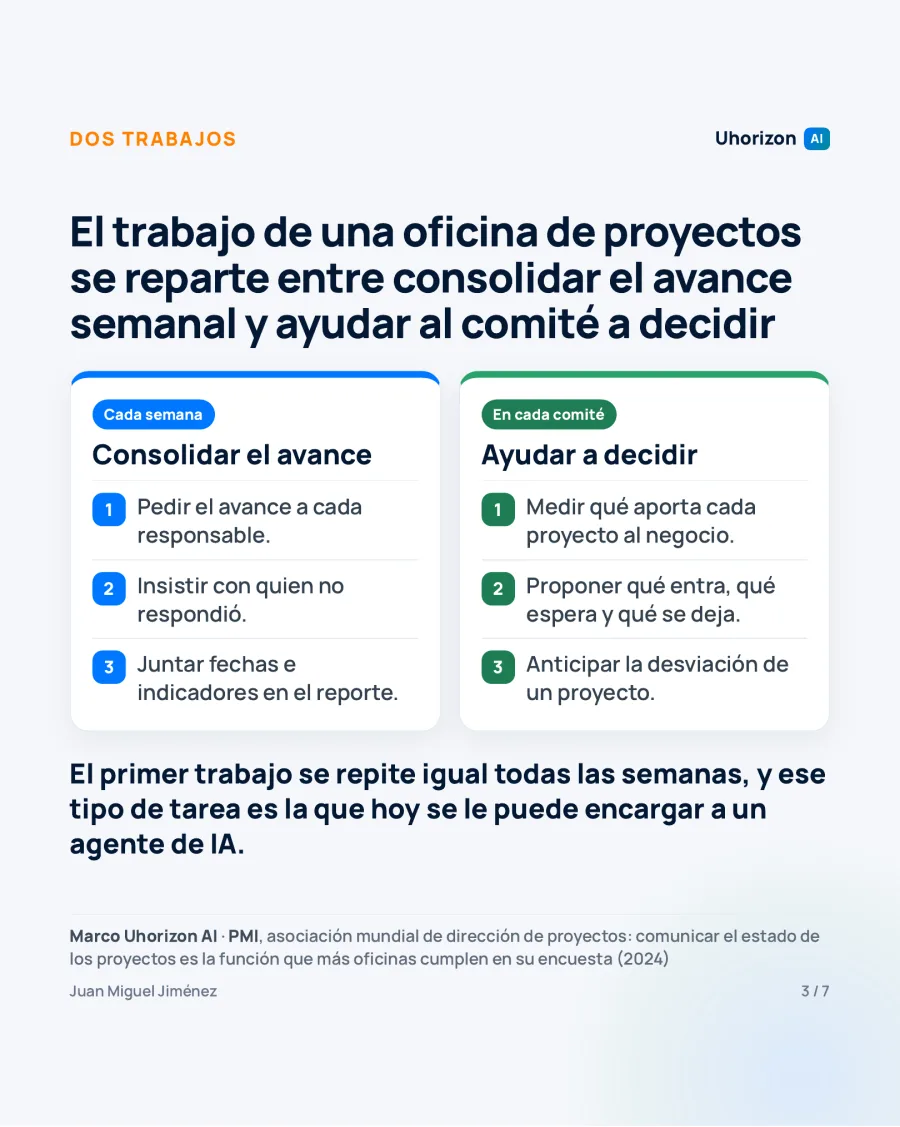
A PMO does two jobs, and the one that repeats every week takes time away from the other
The first job is compiling progress: asking each project lead for an update, following up with whoever didn't answer and pulling dates and metrics into the report. In a global survey by PMI, the worldwide project management association, communicating project status comes out as the most cited function among PMOs.
The second job is helping the committee decide. That means measuring what each project contributes to the business, proposing what gets in, what waits and what gets dropped, and spotting a project drifting off course before it shows up in the results.
Both matter, but they don't get equal time on the agenda. The first repeats the same way every week and has a fixed date, so it almost always wins. The second takes analysis and conversation, and it's the one that tends to get pushed back when Thursday arrives with seven incomplete reports.
And that first job, the one that repeats without changes, is the kind of task you can hand to an AI agent today.
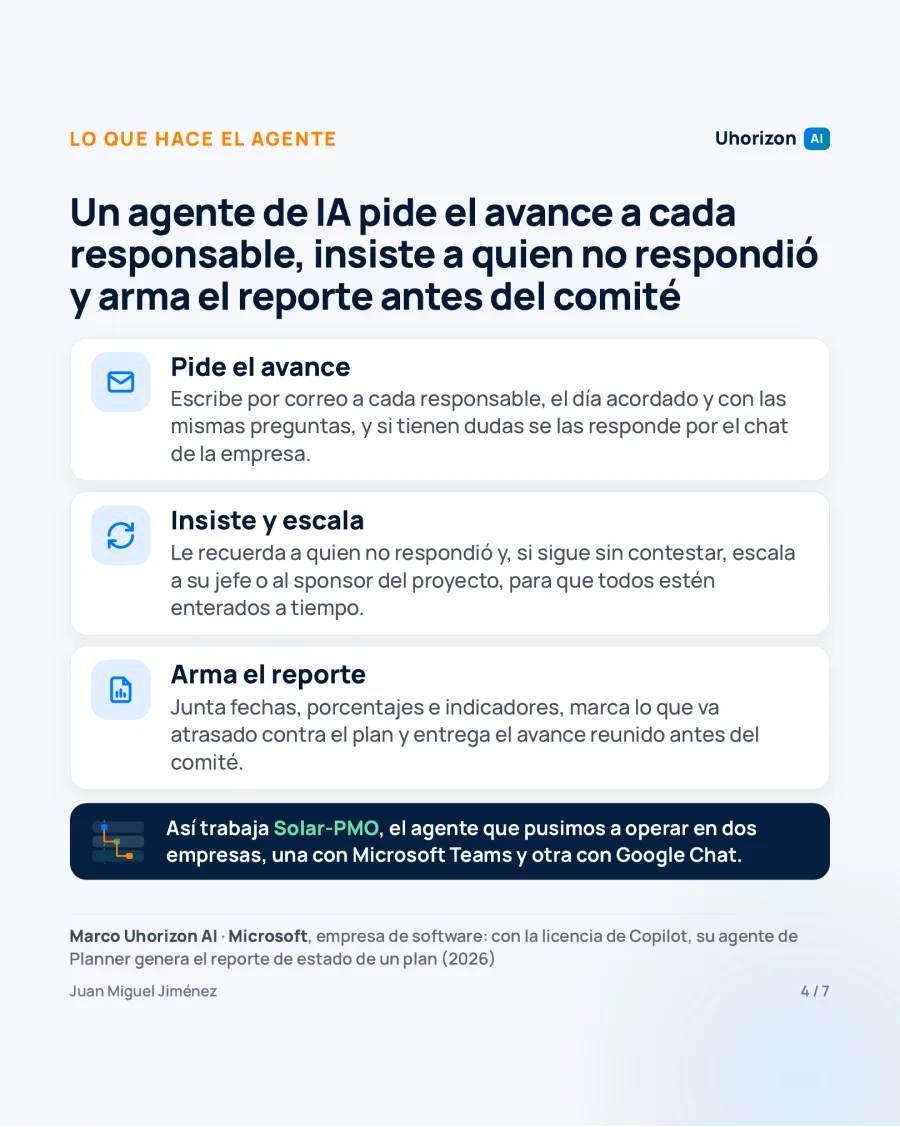
An AI agent can ask for updates, follow up with whoever didn't answer and deliver the report before the committee meets
The agent emails each project lead on the agreed day, always with the same questions, and if someone has questions, it answers them in the company chat. It reminds whoever didn't respond, and if they still don't answer, it escalates to their manager or to the project sponsor, so the delay reaches someone who can fix it before the committee meets. Then it pulls together dates, percentages and metrics, flags what's behind plan and delivers the compiled update before the meeting.
That's how Solar-PMO works, the tracking agent we put to work at two companies, one on Microsoft Teams and the other on Google Chat. I explained how we set it up in this article on weekly project tracking.
It isn't an unusual idea in the market, either. Microsoft, for example, offers an agent in Planner, its task management tool, that generates a plan's status report for anyone with a Microsoft Copilot license, under the conditions Microsoft sets out in its documentation. What's worth checking in any tool is how much of the job it covers: whether it only summarizes what's already been entered, or whether it also asks, follows up and escalates.
With progress already compiled, your PMO can measure impact and prepare the committee's decisions
Here's what really changes. When the updates arrive on their own, the PMO's hours can go to the second job.
Those hours go first to measuring impact. Each project is compared against the business objective and metric it was approved with, and against where the company stood at the start. A project that's almost done and still isn't moving its metric opens a very different conversation from a delayed project that's already showing results.
Then they go to proposing priorities. The PMO brings the committee which project gets in, which one waits and which one gets dropped, with the reasoning in writing.
And finally, they go to spotting drift early. With the agent's alerts on what's already falling behind plan, the PMO presents the project that's drifting off course to the committee, along with the decision that needs to be made about it.
PMI points the same way: it recommends that PMOs measure their contribution to the business and show it to leadership. And the trend goes back a while. In 2019, the research firm Gartner predicted that by 2030, 80 % of today's project management tasks would be eliminated as AI took over data collection, tracking and reporting. It's a prediction, and one from seven years ago, so take it as such, but it points at the same work you can already delegate today.
For the agent to compile progress, your PMO defines who it writes to and who owns it, and changes the committee's agenda
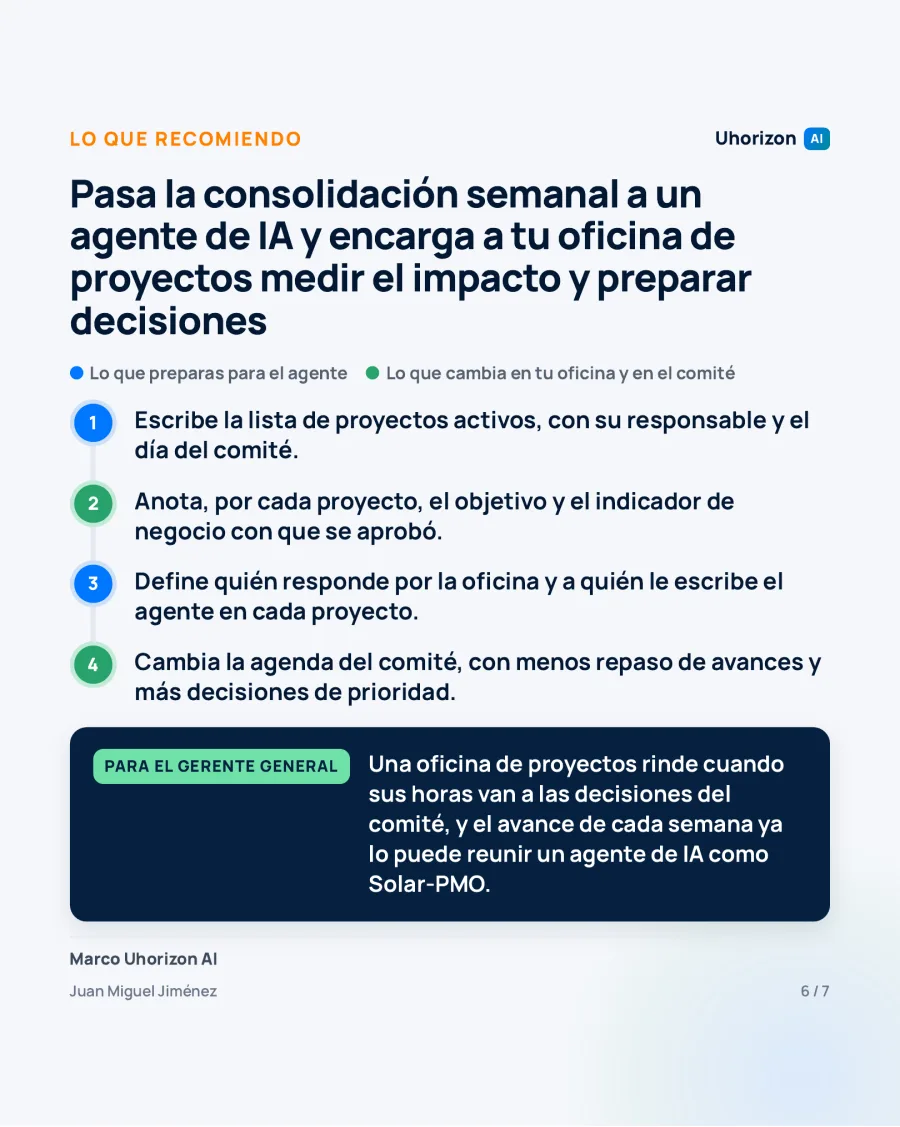
This is what I'd prepare:
- Write down the list of active projects, with their lead and the committee day.
- Note, for each project, the business objective and metric it was approved with, because without that the PMO has nothing to measure impact against.
- Define who owns the agent on the PMO side and who it writes to on each project, including who it escalates to when someone doesn't reply.
- Change the committee's agenda, with less status review and more priority decisions.
The last point is where I'd expect the most pushback. A committee used to going over status tends to keep asking for it, even when it already has it in hand before walking in. That's why I'd change the agenda in writing: the update gets read beforehand, and the meeting starts with the decisions.
Go back to that Thursday, now with progress on all ten projects compiled before you walk in and the drifting one flagged from the start. No gray projects. The committee's hour is enough to decide what gets in, what waits and what gets dropped.
I can show you how Solar-PMO works with sample data in 30 minutes, and then you decide whether it would help your PMO.
If you'd like to talk it through, happy to.
The data and the prediction in this article come from these sources
- PMI (Project Management Institute), the worldwide project management association, October 2024. Built to Thrive: PMOs That Elevate Innovation and Power Transformation. A 2023 global survey of organizations with a PMO, with 1,624 responses. Communicating project status is the most cited function, and the report recommends that the PMO measure and show its contribution to the business.
- Microsoft. Frequently asked questions about Planner Agent. The Planner agent generates a plan's status report and requires a Microsoft Copilot license.
- Gartner, March 20, 2019. Gartner Says 80 Percent of Today's Project Management Tasks Will Be Eliminated by 2030 as Artificial Intelligence Takes Over. It's a prediction about the project management discipline as a whole.
- An AI agent is an assistant that, besides answering, carries out steps on its own, like sending an email or pulling answers into a report.
- The committee week is an illustrative scene. What Solar-PMO does comes from our own operation at two companies, whose names we don't publish. The split into two jobs and the recommendations are Uhorizon AI's own approach.