Why an AI agent stops working well over time
Four reasons an agent that works today drifts, how it shows up in the department, and four questions to size the work of keeping it current.
Juan Miguel Jiménez P. · August 10, 2026 · 6 min read
In any project, almost all the energy goes into the launch: the onboarding, the training sessions, the presentation to the steering committee. And there's one question almost nobody asks at that moment: six months from now, how will you find out that the process stopped working well?
This article is for two stages of a company's AI journey. If you're getting started with AI, it helps you choose the first process well, because the work of maintaining it is also something you choose. If you're already seeing results and want to scale, it helps you sustain what works today before adding more agents.
Everything a company puts in place gets old
A procedure, a report, a template or an automation is built to fit the moment it was made. Over the months the product changes, the policy changes and the person doing the work changes, while that piece stays the same. How many reports do you know that still go out every Monday even though nobody reads them anymore?
The same thing happens with AI as with every other technology, with one difference that matters: the agent keeps answering with the same confidence even when what it knows is out of date. An outdated report gives itself away because the numbers stop adding up. An outdated agent keeps delivering well-written text.
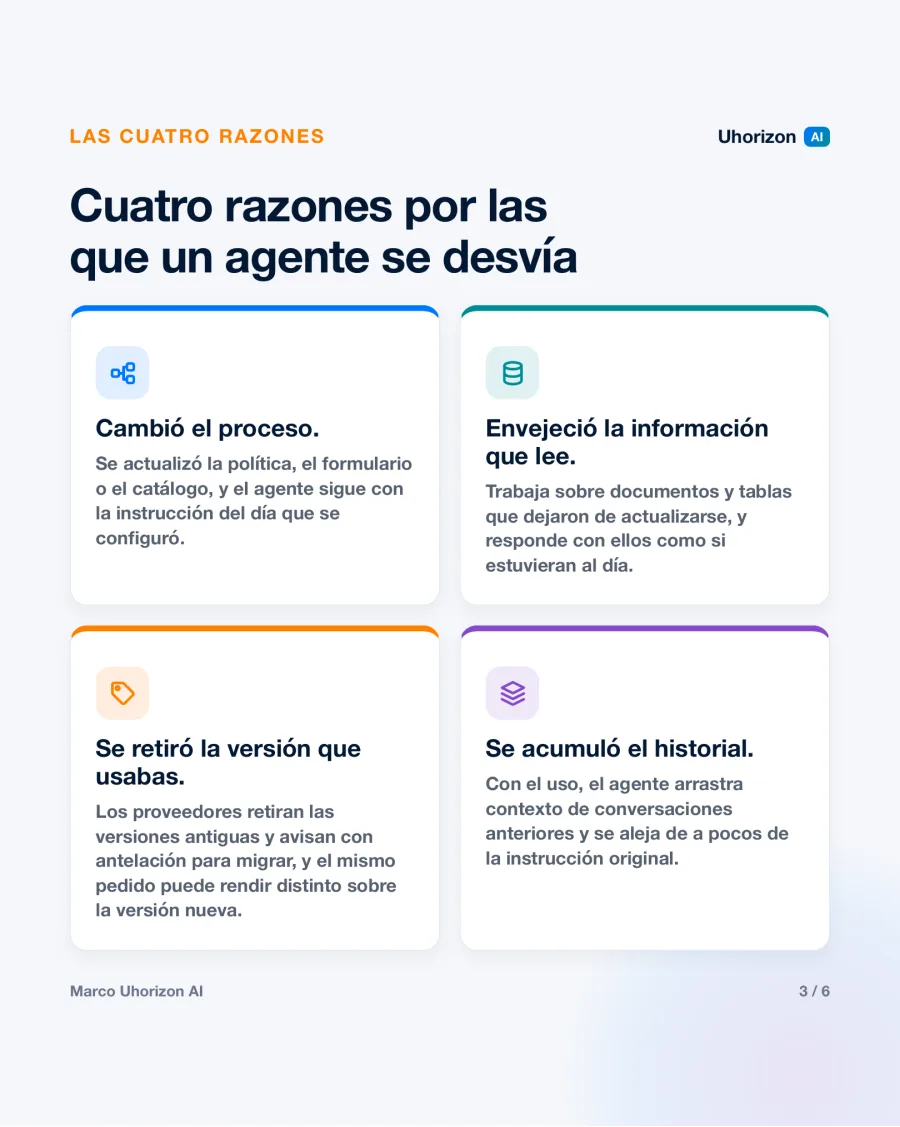
An agent drifts for four reasons
- The process changed. The policy, the form or the catalog was updated, and the agent keeps working with the instructions from the day it was configured.
- The information it reads got stale. It works on documents and tables that stopped being updated, and answers with them as if they were current.
- The model version you were using was retired. Vendors retire older versions. Anthropic, for example, gives at least 60 days' notice and recommends testing your applications on the new model well before the retirement date, because the same request can perform differently on the new version.
- The conversation history piled up. With use, the agent carries context from earlier conversations and gradually drifts away from its original instructions. We see this one in our own operation, with the agents we use every day.
Drift shows up in the process first
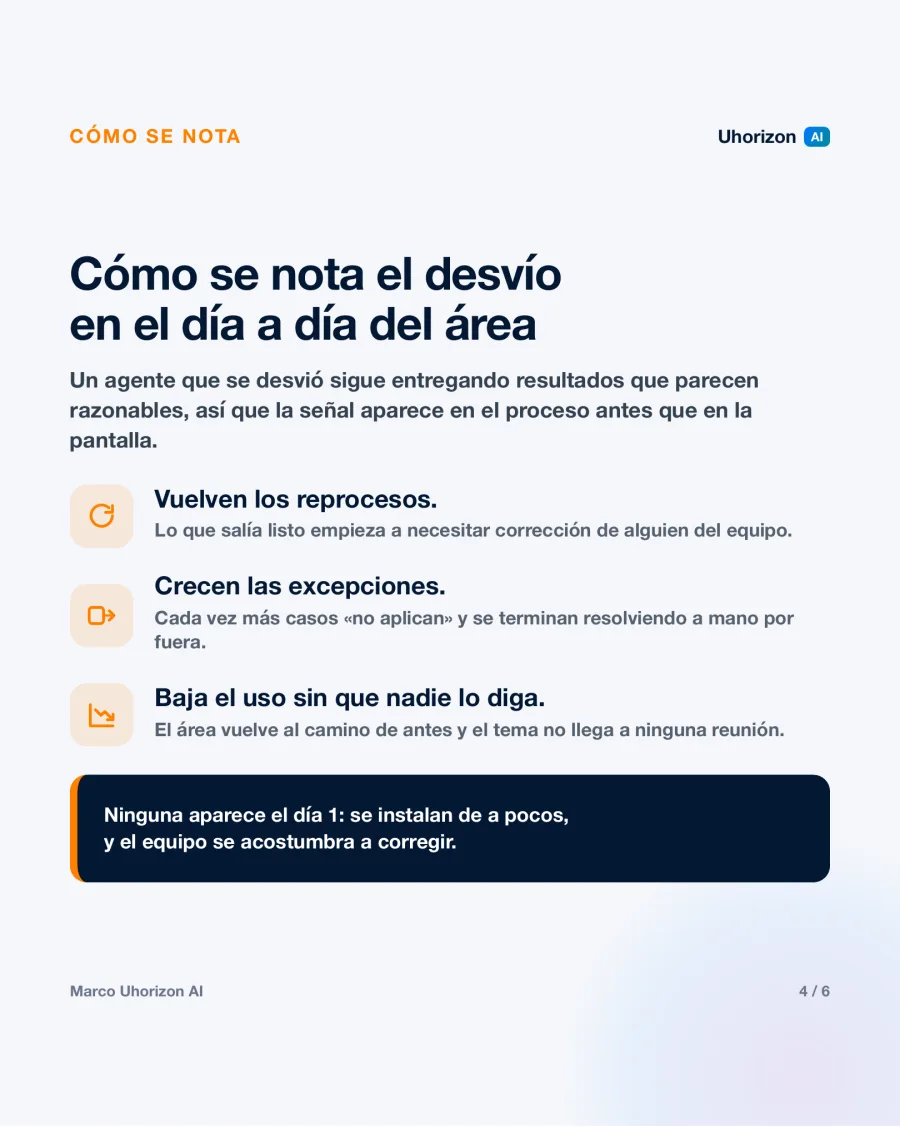
An agent that has drifted keeps delivering results that look reasonable, so the signal shows up in the process before it shows up on screen. Three signs come up again and again:
- Rework comes back. What used to come out ready now needs someone on the team to fix it.
- Exceptions grow. More and more cases “don't apply” and end up being handled by hand, outside the agent.
- Usage drops without anyone saying so. The department goes back to the old way, and the topic never makes it to a meeting.
None of them shows up on day 1. They set in gradually, and the team gets used to correcting.
Here's how it looks in different departments:
- Customer service. An agent that answers with last year's return policy, and a supervisor fixing responses by hand without knowing why there are suddenly so many.
- Finance. One that classifies expenses with a chart of accounts that changed at the last close, and an accountant who reclassifies the same entries every month.
- Sales. One that builds proposals with the old price list, and a sales rep who stops using it because they'd rather build them on their own.
Four questions size the work of keeping an agent current
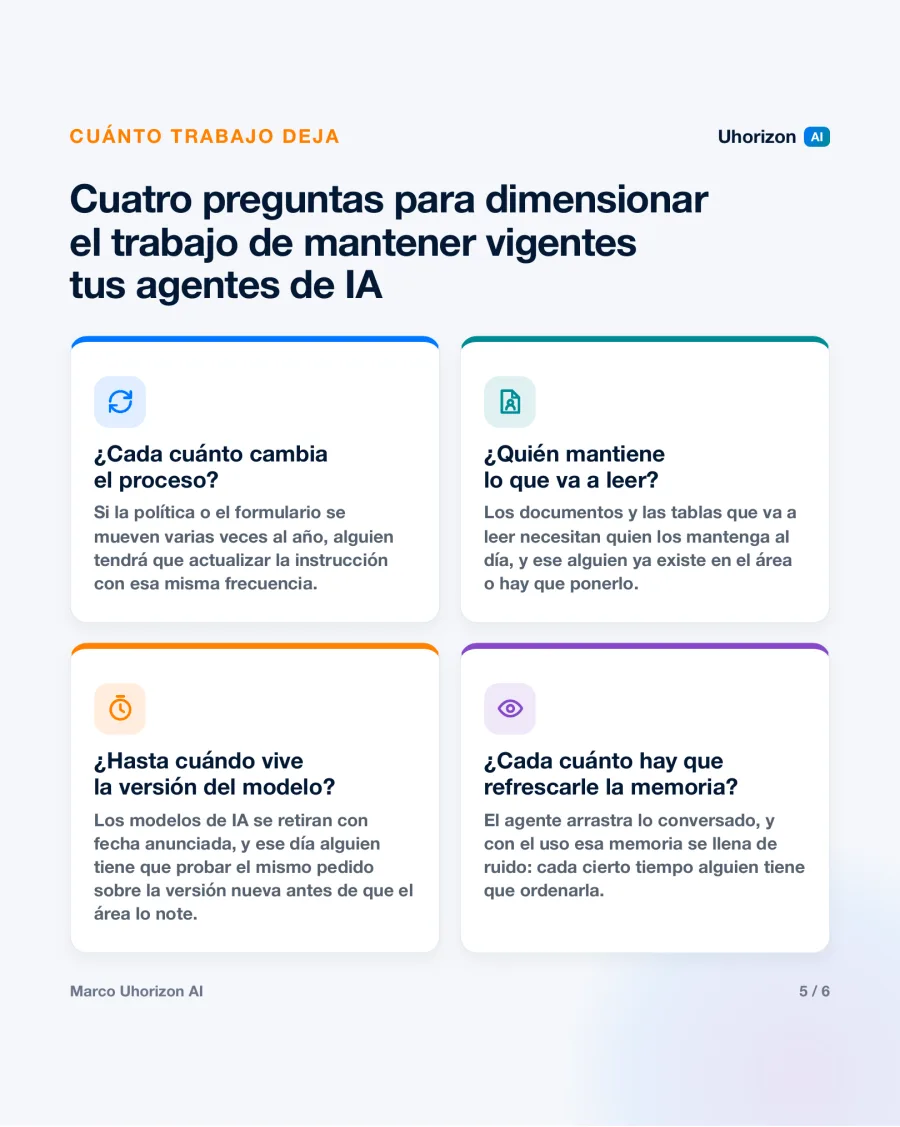
Each reason for drift has its question, and it's worth asking them before you start:
- How often does the process change? If the policy or the form changes several times a year, someone will have to update the instructions just as often.
- Who maintains what it's going to read? The documents and tables it reads need someone keeping them up to date, and that person either already exists in the department or has to be assigned.
- How long will the model version be around? AI models get retired on an announced date, and someone has to test the same request on the new version before that date, so the department doesn't notice.
- How often does what the agent keeps from its conversations need cleaning up? The agent carries what was discussed, and with use that information fills up with noise, so every so often someone has to clean it up.
With those answers you know how much work the rest of the year will take, and that changes which first process you pick. One that changes every month and reads documents nobody maintains can be a bad first bet, even if it promises a lot on paper.
You prepare day 1 thinking about day 200
It's like buying a car. Nobody buys one without asking how often it needs service and who does it, and nobody is surprised that the car needs it. The same goes for an agent, except very few people ask yet when they're making the decision.
In our own operation, what sustains the agents' results comes down to two routines. The first is consolidating what was learned every so often, so the instructions pick up the changes in the process. The second is reviewing the log of what the agent did, in addition to what it answered.
What you can do on Monday: take the process where you plan to put your first agent (or the one you already have running) and answer the four questions in writing. Next to each answer, put a name and a frequency. If any of them is left without a name, you already know where the drift is going to start.
Back to the question at the start: six months from now, how will you find out that the process stopped working well? If you'd like to answer it before you start, let's talk for 30 minutes and choose where to begin.
Sources
- Anthropic, Model deprecations. Model retirement policy, with the minimum 60-day notice and the recommendation to test applications on the new model before the retirement date.
- The four reasons for drift, the signs in the department and the four questions are Uhorizon AI's own method, built on our operation with agents.