Useful AI assistant memory keeps little and someone reviews it
Your AI assistant's memory works when it keeps only what isn't in another system, gets checked against its source and your team can see and correct it
Juan Miguel Jiménez P. · November 21, 2026 · 6 min read
Open your company's shared drive and look for the current version of any contract. How many do you find? If you get four, you're not alone. It happens because nobody decided what goes into that folder or who cleans it up.
Now swap the folder for your team's assistant: who reviews what it remembers?
At Uhorizon, the AI agents we use keep their memory in a file I can open, read and correct. A routine merges what is repeated, resolves what contradicts itself and leaves me a draft, and nothing goes into memory until I approve it. To me, the person who works with the agent is the one best placed to spot a wrong note.
In chapter 5 of the series "AI in your company," Louis and I talked about what AI can remember about you, about the department it works in and about where each agent left off with its task. What we left open was how to keep that memory useful over time.
In an Anthropic test, the version of Claude that kept fewer notes got further in the game
According to Anthropic, they gave two versions of Claude a folder for notes while they played a video game and measured how far each had gotten after about 10,000 steps, counting badges.
The older version saved 413 files across 225 folders, often one for each battle, each item and each character, plus data the game was already showing on screen. It reached one badge. The newer version saved 9 files in 2 folders, plus a main one with its current goal, its plan and its own rules for using memory. It reached four.
A word of caution: it's a single run per version, and the newer one is a more capable model, so memory doesn't explain the whole gap. Still, the pattern feels familiar to me: saving everything filled memory with things that were already in plain sight, like that folder with four contracts.
Think of a good executive assistant's notebook. You won't find customer balances in there, because they check those in the accounting system every time someone asks. What they write down is what isn't written anywhere else, like the supplier who always delivers late, and when something changes, they cross it out and fix it. That's how I want an AI assistant's memory to work.
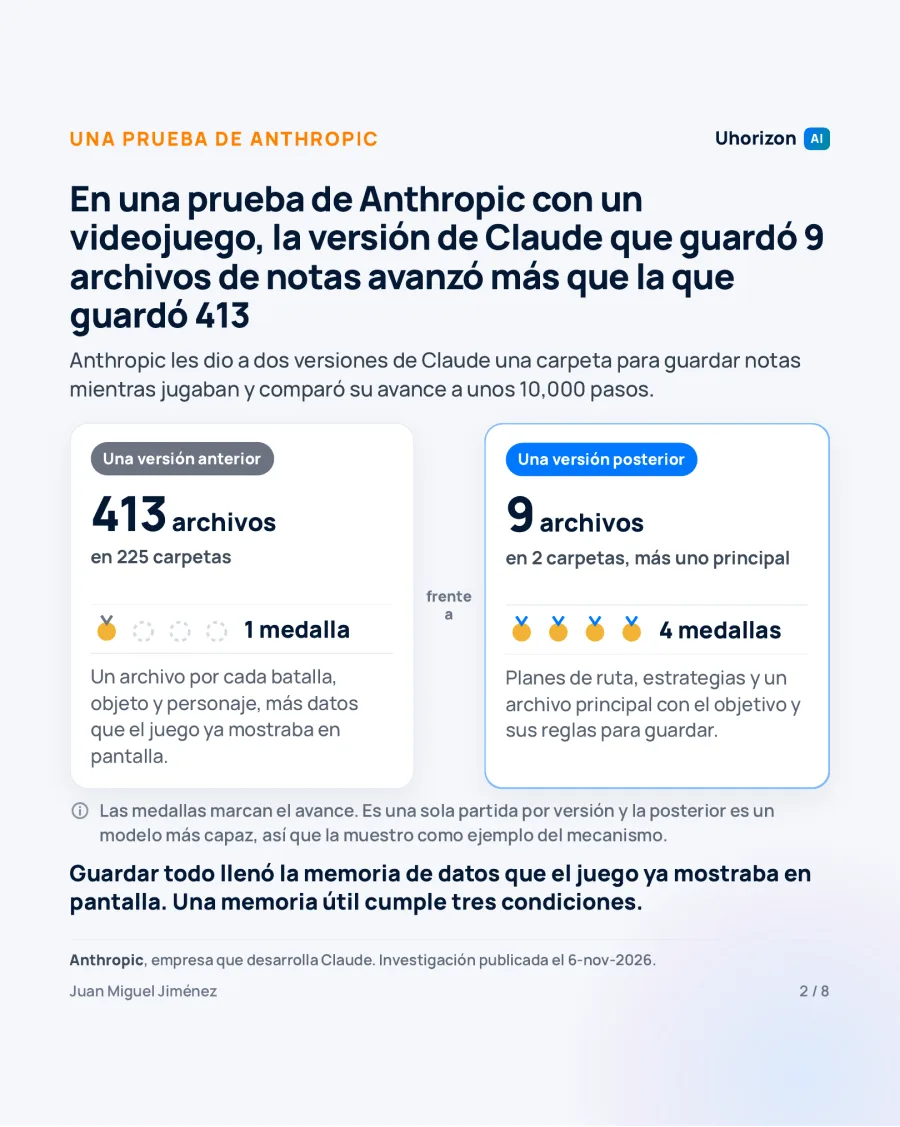
Your AI assistant's memory should keep only what it can't look up in any system
I recommend the assistant keep in memory what isn't in another source: rules that have been confirmed, how a recurring task was solved and mistakes not to repeat. A customer's balance, an order's status or the current price get looked up in their system every time.
Why so careful? Because a saved copy stops being true when the data changes, and the assistant may never find out. If it wrote down a product's price in October and the price changed in November, it will keep quoting October's price. In the Anthropic test, the 413-file version wrote down its money and its position on the map, even though it had both on screen every turn.
Saving too much is a mistake too.
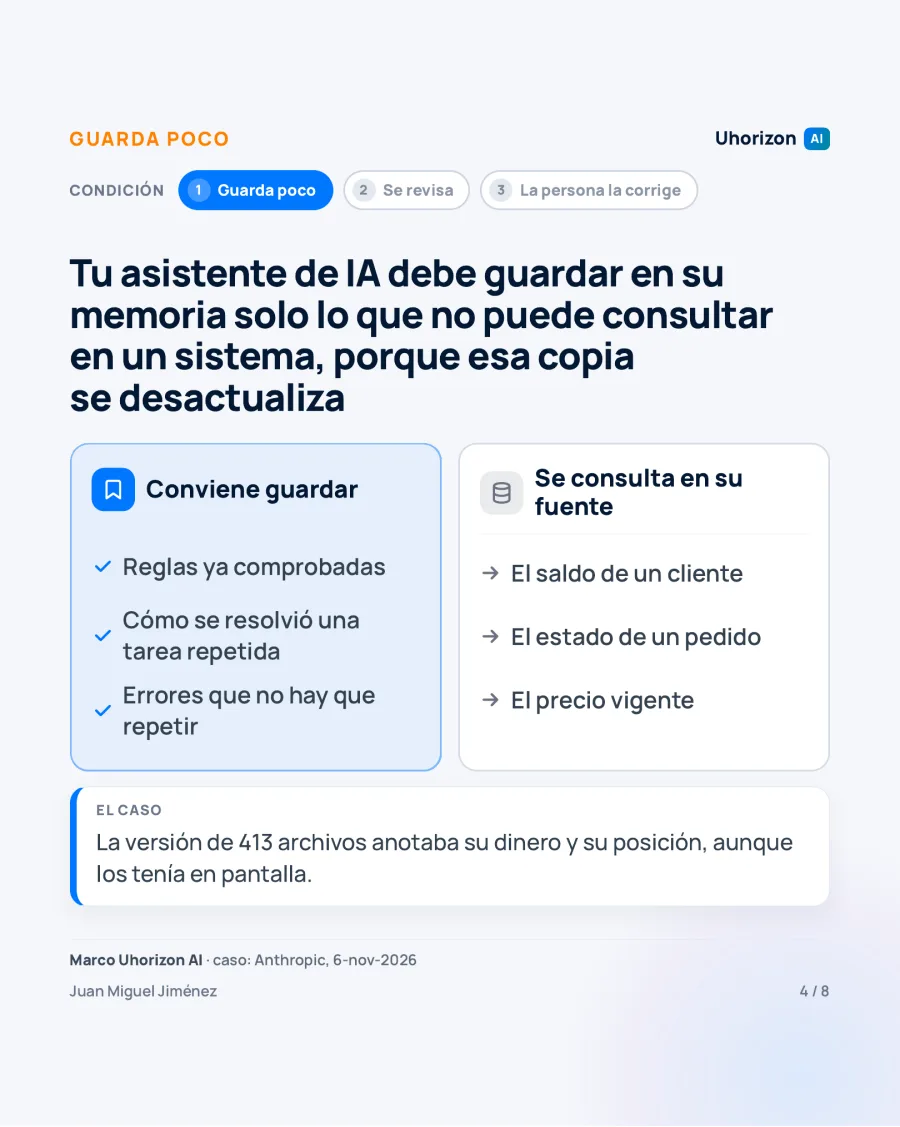
A wrong note in an AI assistant's memory keeps repeating until someone checks it against its source
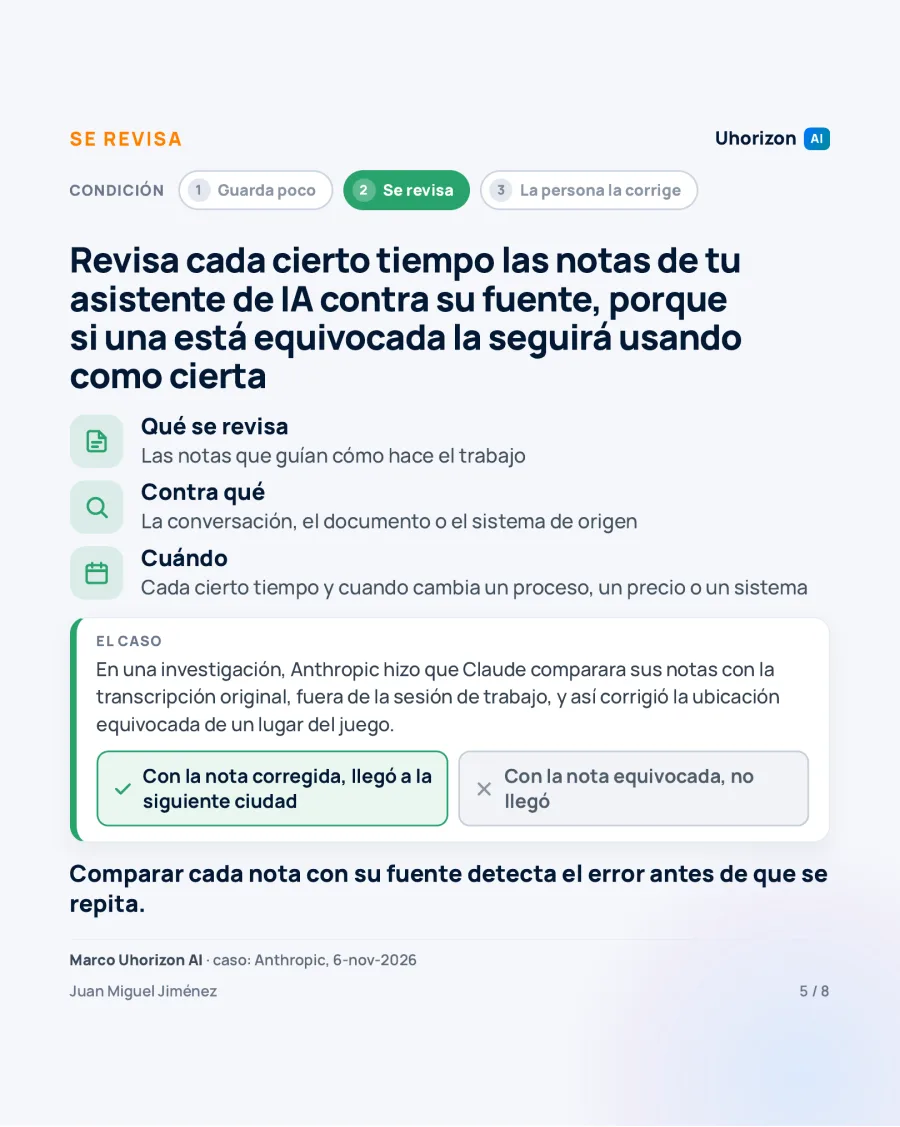
The assistant treats its notes as true, including the wrong ones. According to Anthropic, the assistant can read a note that was wrong from the start, or that went stale when the environment changed, in a later session and trust it.
In the same research, Claude compared its notes with the original transcript of a run, outside the game session, and found it had the location of a place in the game written down wrong. With the corrected note, it reached the next city. With the wrong note, it got stuck in the mountain. This is also a single test, and Anthropic itself acknowledges that this review uses compute and that it still has a lot to learn about designing memory.
How does that carry over to a company? I'd start with the notes that guide how the assistant does the work, because they do the most damage when they're wrong. I'd compare them with whatever they came from, whether a conversation, a document or the system, every so often and especially when a process, a price or a system changes. That's when a correct note stops being correct.
Whoever works with the AI assistant needs to be able to see what it remembers and correct it
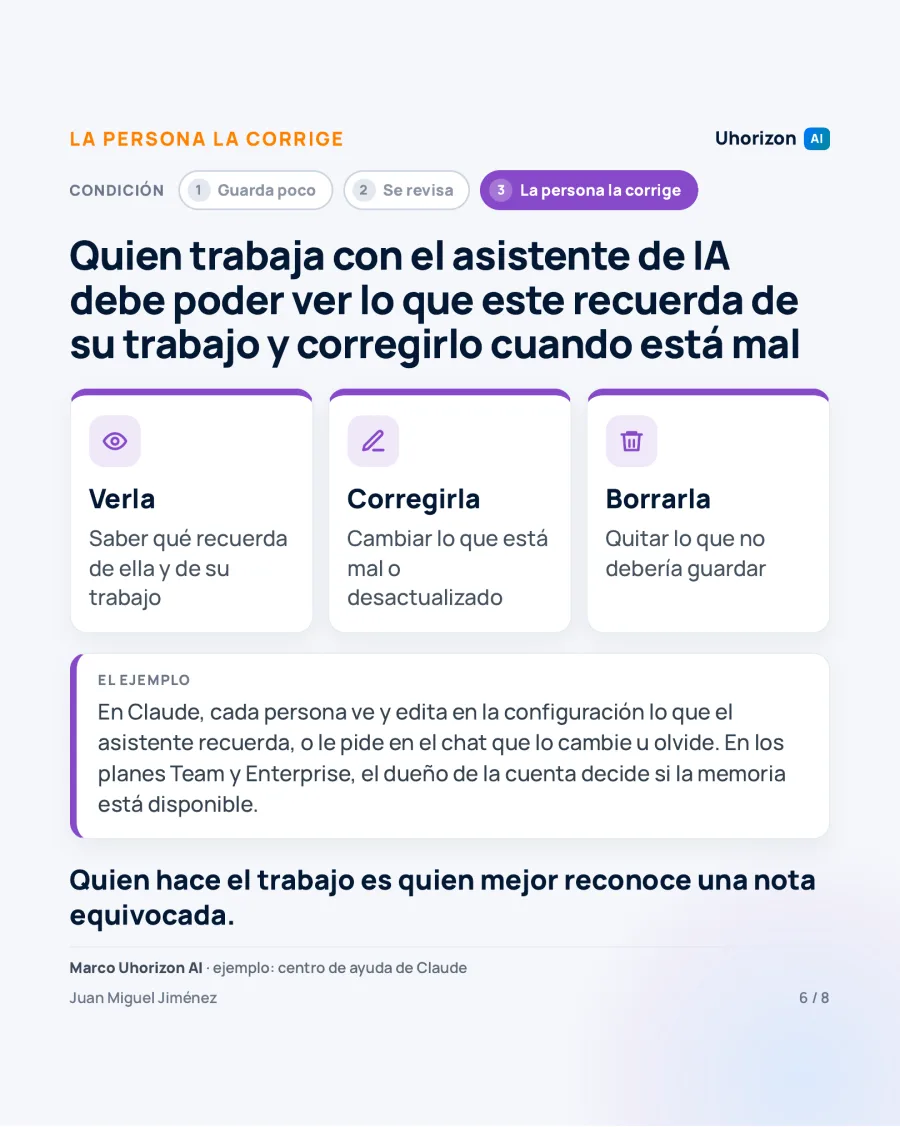
Whoever works with the assistant should be able to open its memory, see what it remembers about their work, correct what's wrong or outdated and delete what shouldn't be there.
Claude handles it this way in its chat. According to its help center, each person can view and edit what the assistant remembers in settings, or ask it in the chat to change or forget something. On Team and Enterprise plans, the account owner decides whether memory is available to the organization.
A memory nobody can open is a memory nobody corrects.
An AI assistant's memory needs an owner, just like any other company record
If you wanted to get your team's assistant memory in order tomorrow, I'd start by naming one person to review it against the original record every so often and every time a process changes. A task that belongs to everyone ends up not getting done.
That person also decides what goes in (confirmed rules, recurring tasks, mistakes to avoid) and makes sure balances, orders and prices keep getting looked up in their system. And if the tool doesn't let you see or correct what the assistant remembers, I wouldn't turn memory on yet.
In the end, the assistant's memory looks a lot like that shared folder from the beginning. If nobody decides what goes in or who reviews it, in a few months you'll have four versions of the same rule, and the assistant will use any one of them.
If you'd like to talk it through, happy to.
The figures and cases in this article come from these sources
- Anthropic, the company that develops Claude, November 6, 2026. The components of agent memory. Vendor experiment, with one run per version.
- Claude Help Center. Using Claude's chat search and memory to build on previous context
- In the series "AI in your company," an agent is an AI assistant specialized in one area.
- The notebook analogy, what to keep and what to look up, how to review and the recommendations are Uhorizon AI's own criteria.