Six questions to decide whether an AI pilot is ready to start
Before you approve an AI pilot, optimize the process it will change. Six operations questions to check that it's ready.
Juan Miguel Jiménez P. · October 28, 2026 · 5 min read

Before you approve an AI pilot, it pays to review the process it's going to change. If that process has an approval that gets repeated or data scattered across several spreadsheets, or if nobody knows who signs off on the result, AI will repeat those same problems, only faster. Sound familiar in your area?
This article is for anyone about to approve their first AI pilot. It covers why it makes sense to optimize the process before turning it into an agentic process, where AI agents carry out the steps and people make the decisions, and the six questions I go through before starting, with what to look for in each one and what to do when there's no answer.
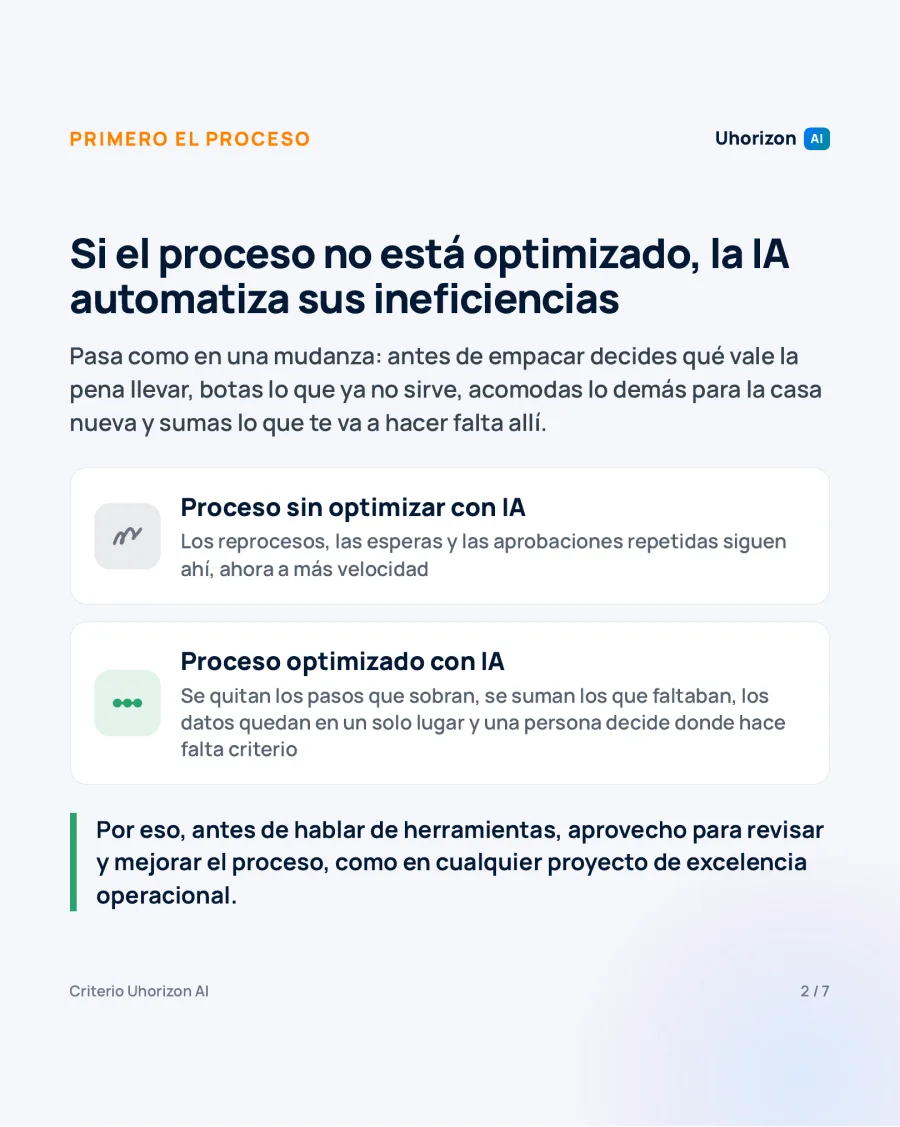
If the process isn't optimized, AI automates its inefficiencies
Think of it like packing for a move. Before you pack, you decide what's worth taking, you throw out what you no longer need, you arrange the rest for the new place and you add what you'll need there. If you pack everything without choosing, you also bring along what was useless.
A process works the same way. If you put AI on top of a process that hasn't been optimized, the rework, the waiting and the repeated approvals are still there, now at higher speed. If you optimize it first, the extra steps come out, the missing ones go in, the data sits in one place and a person decides wherever judgment is needed.
That's why, before talking about tools, I use the opportunity to review and improve the process, as in any operational excellence project. AI comes in afterward, as one more technology applied to a process that already works well.
Six questions I go through before starting a pilot
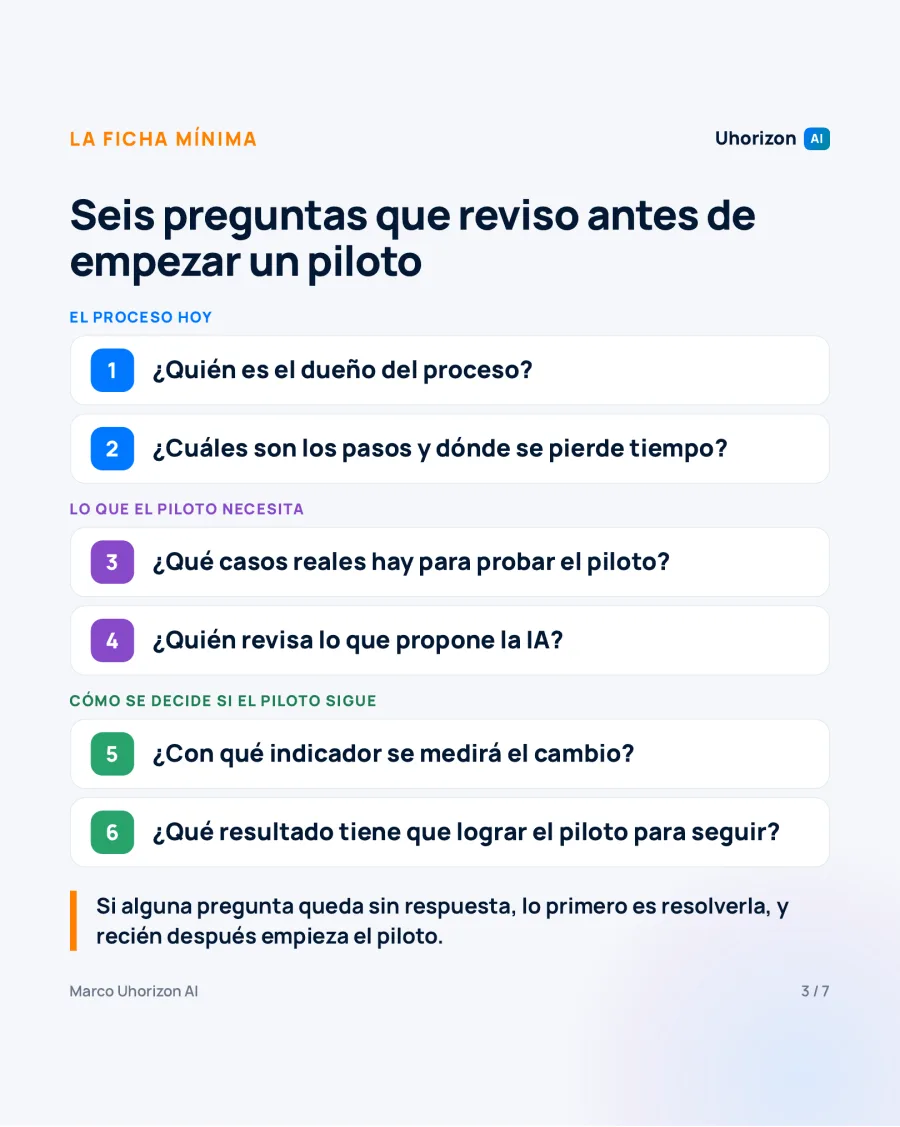
The questions come from any improvement project, grouped into three blocks:
- The process today. 1 · Who owns the process? 2 · What are the steps, and where is time lost?
- What the pilot needs. 3 · Which real cases can you test the pilot against? 4 · Who reviews what the AI proposes?
- How you decide whether the pilot continues. 5 · Which metric will measure the change? 6 · What result does the pilot have to reach to continue?
If any question has no answer, the first step is to resolve it, and only then does the pilot start. The short one-pager these questions form is our own proposal. To show it in practice, I pair it with an illustrative example: approving a purchase, a process almost every company has.
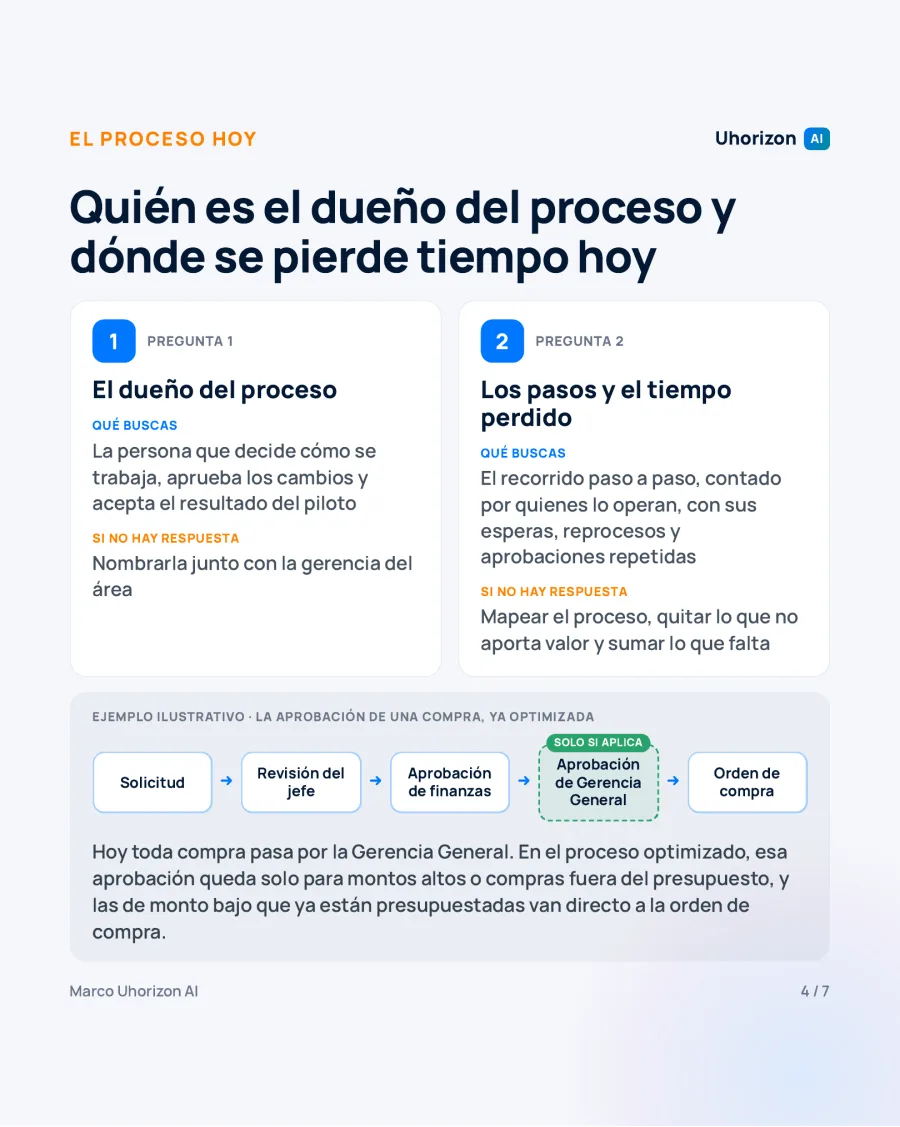
The first two questions look at the process as it runs today
1 · The process owner. You're looking for the person who decides how the work is done, approves changes and accepts the result of the pilot. If there's no answer, you name that person together with the department head.
2 · The steps and the lost time. You're looking for the step-by-step path, as told by the people who run it, with its waiting, rework and repeated approvals. If there's no answer, you map the process, remove what adds no value and add what's missing.
In the example, a purchase goes through the request, the manager's review, finance approval, CEO approval and the purchase order. Today every purchase goes through the CEO. In the optimized process, that approval is kept only for large amounts or purchases outside the budget, and small purchases that are already budgeted go straight to the purchase order.
Questions 3 and 4 call for real cases and a person who reviews
3 · The cases to test. You're looking for real cases with what came into the process and the correct result, stored somewhere they can be looked up. If there's no answer, you gather a sample of recent cases with their results.
4 · The person who reviews. You're looking for someone who knows the process, recognizes a mistake and has hours set aside to review. If there's no answer, you assign a person by name and block those hours in their week.
In the example, the cases are last quarter's purchase requests, with the decision made on each one. The head of purchasing reviews every AI proposal before the request is approved.
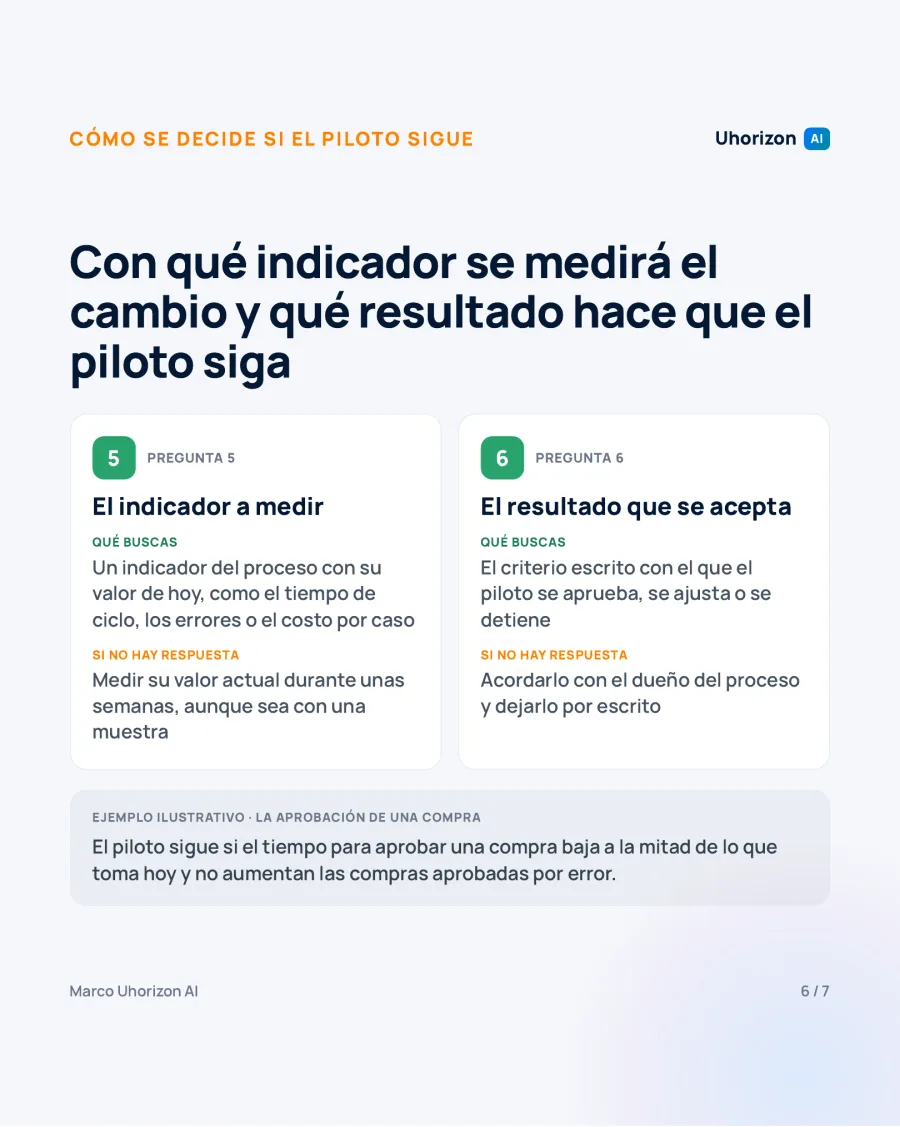
Questions 5 and 6 put in writing when the pilot continues
5 · The metric to measure. You're looking for a process metric with today's value, such as cycle time (how long a case takes from start to finish), errors or cost per case. If there's no answer, you measure its current value for a few weeks, even if only with a sample.
6 · The accepted result. You're looking for the written criterion under which the pilot is approved, adjusted or stopped. If there's no answer, you agree on it with the process owner and put it in writing.
In the example, the pilot continues if the time to approve a purchase drops to half of what it takes today and purchases approved by mistake don't go up. That half is an example number to show how a criterion is written, and each company sets its own with the process owner.
The optimized process is the one you later make agentic
In operational excellence, an improvement project usually starts with a charter that names the process owner, the scope and the metric to move. I've spent more than 14 years as a business consultant, and with AI I apply the same discipline: I use the project to optimize and improve the process, and then we turn it into an agentic process, with agents that execute and people who decide.
The six questions do for an AI pilot what that charter does for an improvement project. If a process in your area came to mind as you read them, let's talk for 30 minutes and choose the process for your first pilot.