How to write down what your team keeps explaining to AI
What your team keeps repeating to AI fits into two company files, and with them an agent got more right and spent less
Juan Miguel Jiménez P. · November 16, 2026 · 7 min read

Have you ever had to switch accounting systems? If you have, you know that installing the new system is the easy part. The hard part is getting back everything people knew how to do with the old one: the shortcuts, the exceptions, that one client who always wants the invoice a certain way and whom only one person on the team remembered.
The exact same thing is happening with AI, and I think very few executives are paying attention to it. Everyone on your team already has their own way of explaining to ChatGPT or Claude what the company does, how work gets done and what result they expect, and that explanation lives in their chat history. If you switch tools tomorrow, or if that person leaves, what's left?
Little or nothing… unless someone wrote it down.
AI starts every conversation without knowing how your company works
Every new conversation starts without that knowledge, apart from the little the tool has saved. So someone on the team explains it all over again: who they are and who they serve, how the work gets done and what's off limits, and what result they expect, with the format, the length and, if there's time, a good example. They explain it today, explain it again tomorrow, and it comes out a little different every time.
Think of it like a new hire you have to walk through their job from scratch every morning. You both lose time, and every day the explanation comes out different. Would you put up with that for a week with someone on your team?
With AI, we put up with it every day.
What your team keeps repeating to AI fits into two files the company keeps
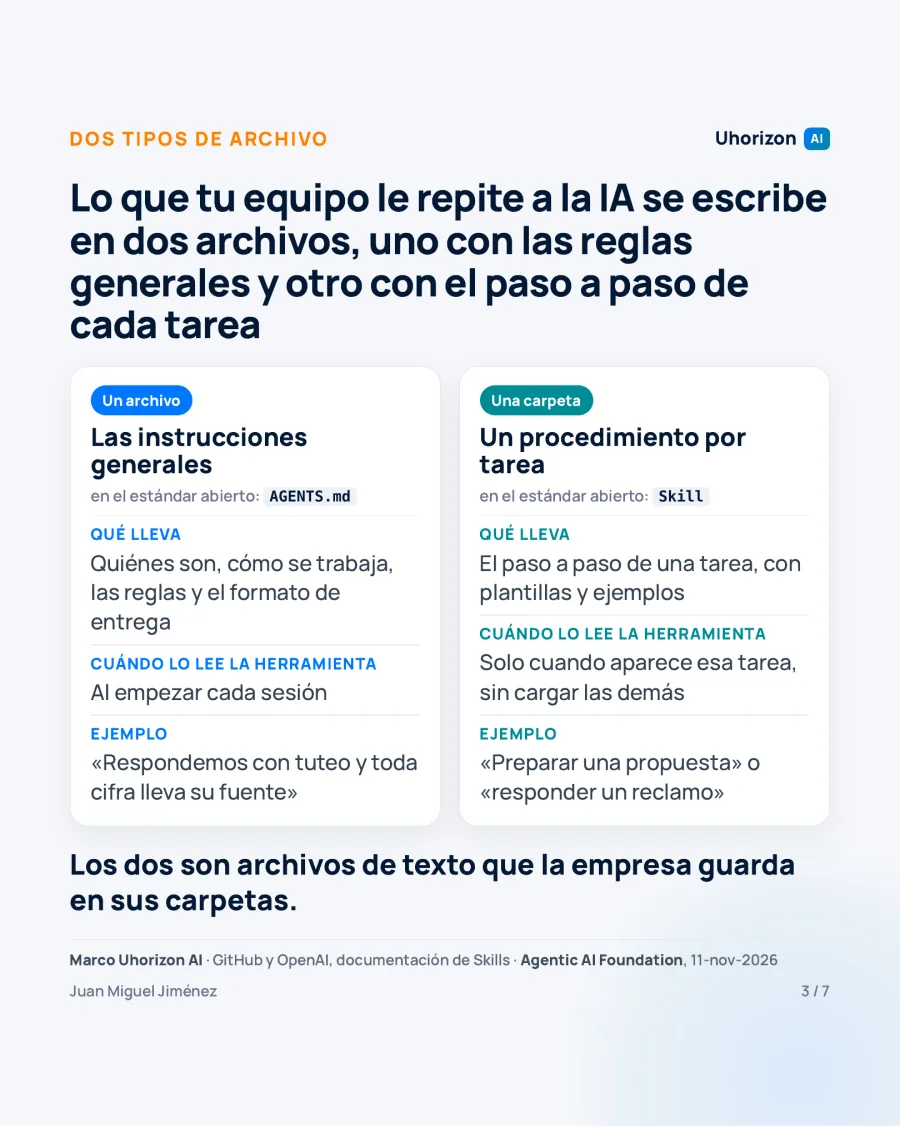
The first is a general instructions file, covering who you are, how you work, the rules and the delivery format. The tool reads it at the start of every session, and the file holds sentences as simple as "We write in a friendly, first-name tone, and every number comes with its source." In the open format that any tool can adopt, that file is called AGENTS.md.
The second is a procedure for each task, which in that same format is called a Skill. It's a folder with the step-by-step for one task, its templates and its examples, like "prepare a proposal" or "respond to a complaint," and the tool opens it only when that task comes up, without loading the rest. GitHub uses it in its assistant and OpenAI uses it in ChatGPT.
Both are text the company keeps in its own folders, and that's what matters most: what your team knows how to do with AI stays with the company. On top of that, both formats are now in the hands of a foundation under the Linux Foundation, which OpenAI and Anthropic handed them over to.
In a published test, a file of about 50 lines got an agent to do better work for less
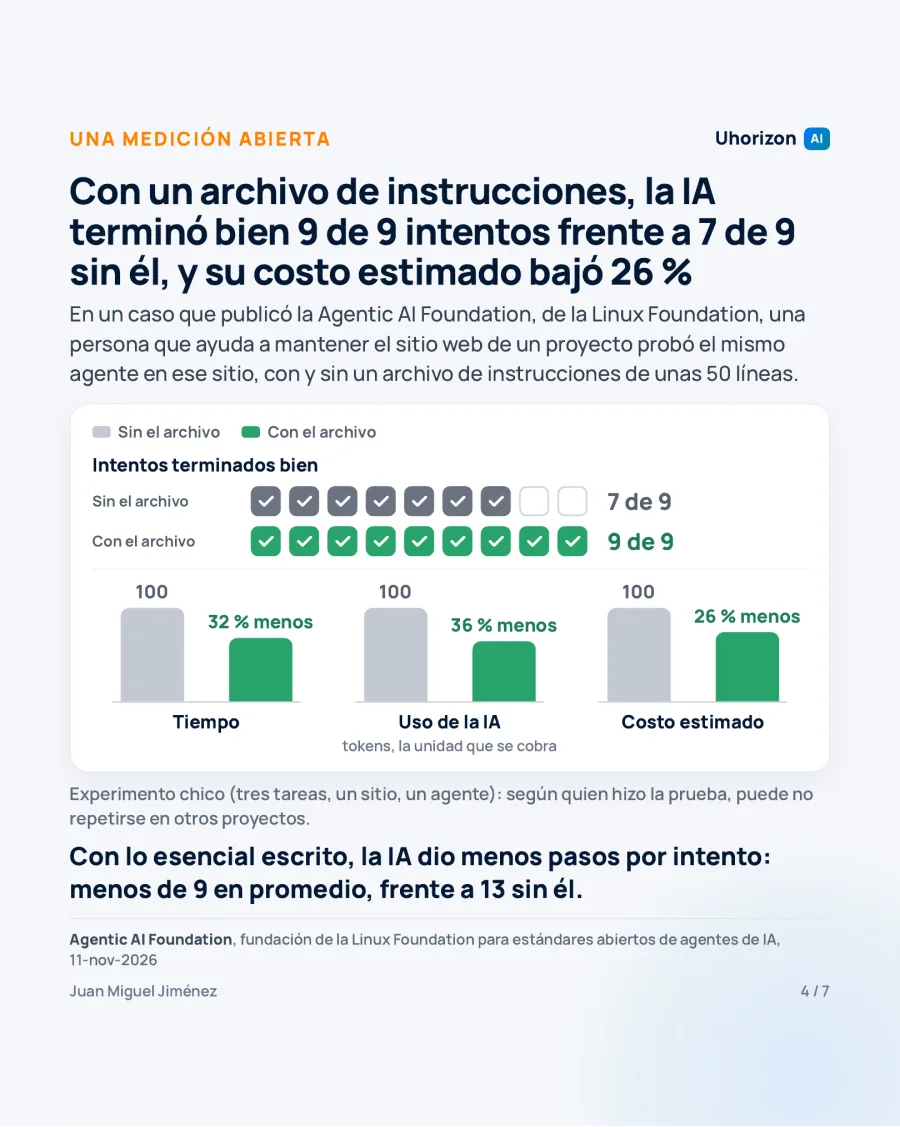
Does writing it down actually help, or is it just tidiness? There's a case published by the foundation that maintains AGENTS.md that answers exactly that question. Someone who helps maintain the website of a Linux Foundation project tested the same agent on that site, with and without an instructions file of about 50 lines. (An agent is an AI assistant that, besides answering, takes steps on its own, like reading and changing the site's files.)
With the file, the agent got all 9 runs right; without it, 7 of 9. It took 32% less time, used 36% fewer tokens (the unit you're billed in when you use AI) and its estimated cost dropped 26%. But the number I liked most is a different one. Without the file, the agent took 13 actions per run on average, and with the file, fewer than 9. That is more than four fewer actions every time you ask it for something.
Keep in mind it's a small experiment: three tasks, one website and one agent. The person who ran the test warns that the result may not hold up on other projects, and the cost was calculated at list prices. So take it as a signal. That said, it matches something every executive already knows: whoever shows up and finds things written down doesn't have to guess them every time.
With the rules written in company files, your whole team works with AI the same way
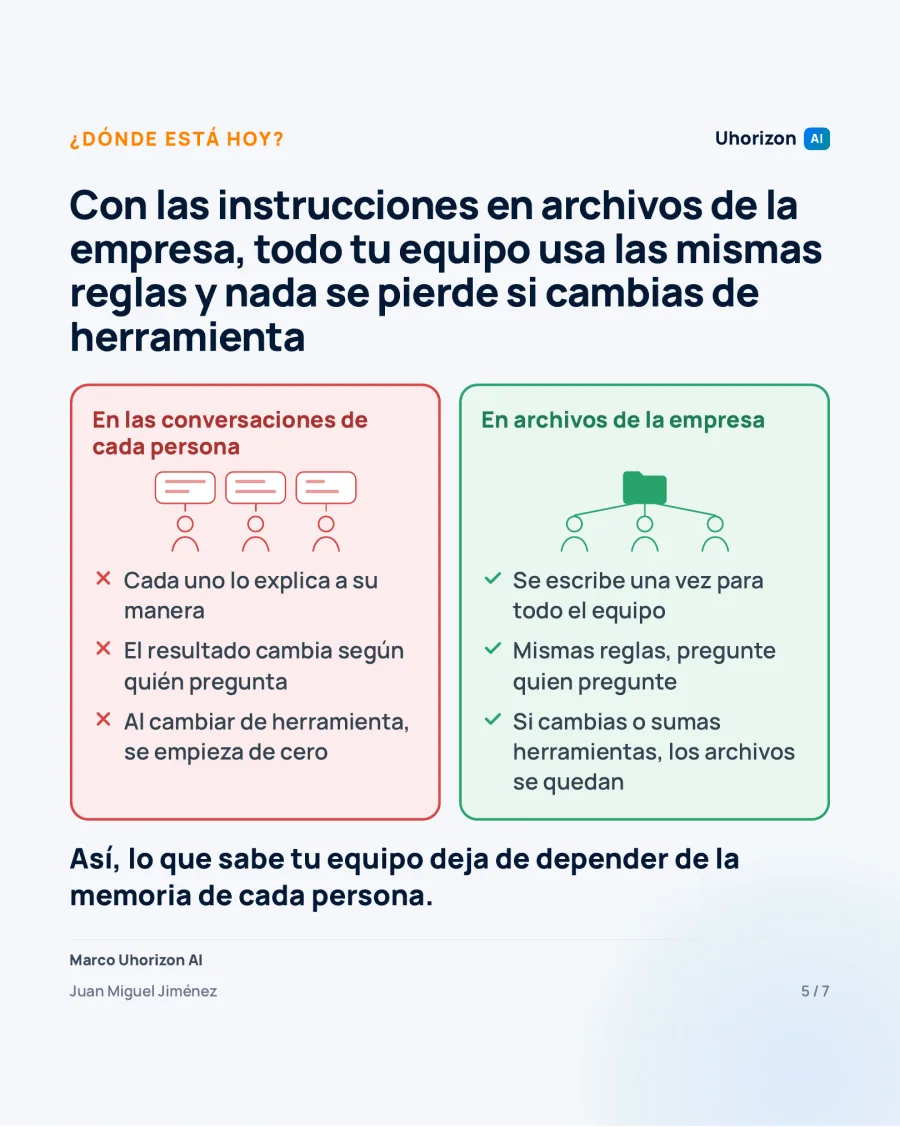
Picture three salespeople asking AI for a draft proposal. Each one explains the company their own way, so you get three proposals with different timelines, different terms and even a different tone. And who ends up fixing all three? The sales manager.
If the rules live in an instructions file and there's a procedure for "prepare a proposal," all three come out with the same structure and the same terms, no matter who asks. Then the manager can focus on the real job, which is deciding whether the proposal makes sense for that client.
There's one more advantage, and you notice it the day you have to choose a vendor. Since the format is open and several tools read it, you can switch tools, or use two depending on the task, and your files keep working.
The first step is writing down what your team explains to AI in a single process
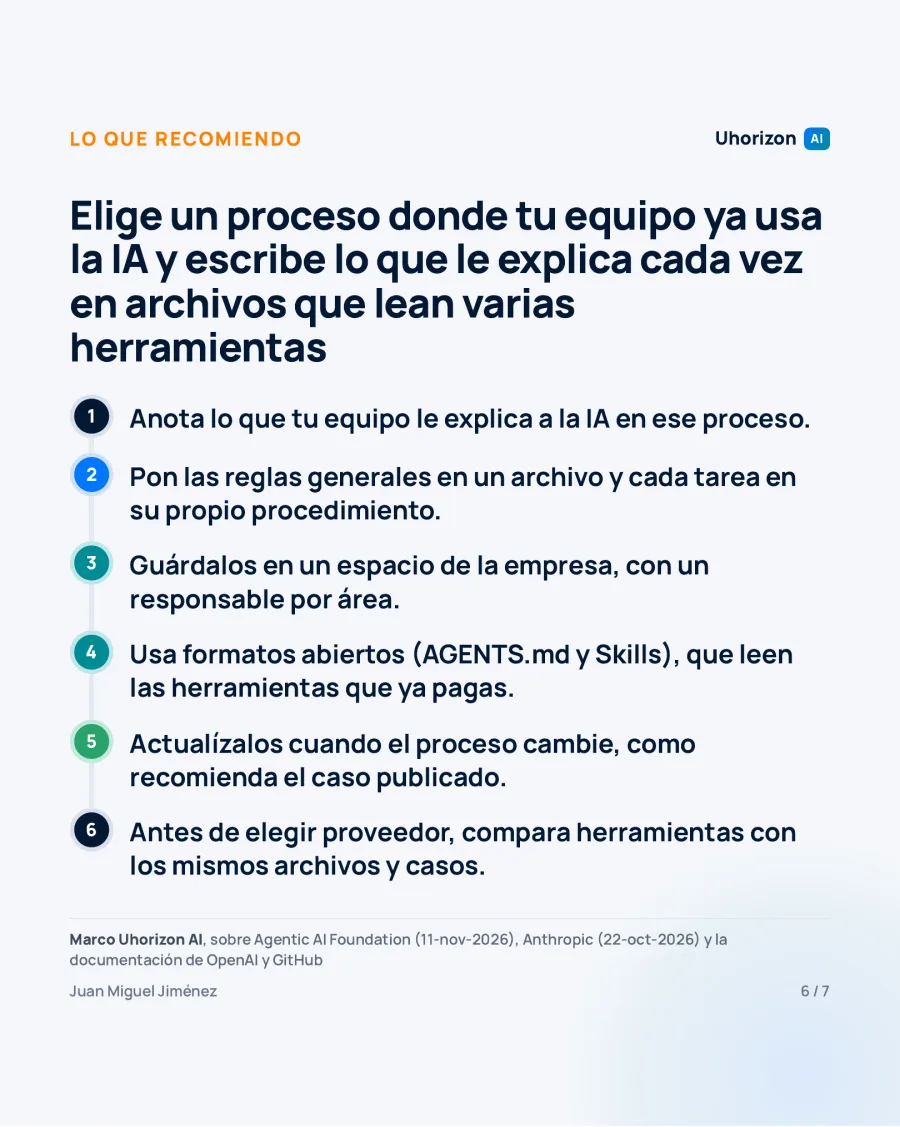
I'd start with a single process where your team already uses AI, ideally one you know well. And I'd go in this order:
- Write down what your team explains to AI in that process, because that's where almost everything that later goes into the files comes from.
- Put the general rules in one file and each task in its own procedure, because the rules get read every time and each procedure only when it's needed.
- Store them in a company space, with an owner for each area, because a file nobody looks after stops matching the real process.
- Use the open formats, AGENTS.md and Skills, and check that the tools you already pay for can read them, because that way you don't have to rewrite them if you switch tools.
- Update them every time the process changes, because with the file the agent checks less on its own and relies on what the file says, as the person who ran the test points out.
- Compare vendors using the same files and the same cases, because that way the comparison is based on your company's real work.
In chapter 5 of our series "AI in your company," Louis and I talk about why you have to explain everything to AI every time and how to organize that behind the scenes. You can watch it on YouTube.
In the end, it's the same story as the accounting system at the start: whatever nobody wrote down leaves with the person who knew it. The only new part is that now AI reads the procedure too, and if it's written down, it still belongs to your company even when you switch tools.
If you'd like to talk it through, I'm happy to.
The numbers, the case and the formats in this article come from these sources
- Agentic AI Foundation, November 11, 2026. DevEx for your agents: how AGENTS.md cut token usage and cost. The test was run by someone who helps maintain the website of a Linux Foundation project. It's a small experiment (three tasks, one site and one agent), with cost estimated at list prices.
- GitHub Docs. About agent skills. Defines Skills as folders of instructions, scripts and resources that its assistant loads when they're needed.
- OpenAI. Build skills. Documents the same format for ChatGPT and for Codex, its coding tool.
- Anthropic, October 22, 2026. Donating Agent Skills to the Agentic AI Foundation. Anthropic hands the Skills standard over to the Agentic AI Foundation.
- Linux Foundation, December 9, 2025. Linux Foundation announces the Agentic AI Foundation. The foundation is launched as a home for open standards for AI agents, and OpenAI contributes AGENTS.md.
- The three-salespeople example and the steps to get started are Uhorizon AI's own approach.