How to tell whether your company needs one AI agent or several
The question that decides whether you need one AI agent or several, what MCP and A2A solve and three things to ask for before approving a proposal.
Juan Miguel Jiménez P. · August 12, 2026 · 5 min read
Almost every technology project runs into the same decision: how much gets built now and how much gets left for later. I saw it with ERP systems, with portals and with integrations between systems. The proposal comes in with the full version, the steering committee approves all of it and, over the years, a good part of what was built never gets used.
In AI, the word that comes with the full version today is “multi-agent.” This article is for the company about to set up its first agent, and also for the one whose AI projects aren't delivering results because they were designed bigger than the problem called for.
The word multi-agent hides two different jobs
When an AI proposal comes in with the full version, it almost always carries that word, and with it several agents, several layers and a long integration plan.
Underneath there are two different jobs, and each one has its open standard. The first is connecting an agent to your systems. The second is coordinating several agents with each other. Does your case need both today? That question is what decides when you see the first result, because the fewer layers you need at the start, the sooner it arrives.
Connecting and coordinating each have their own standard
Connecting is handled by MCP (Model Context Protocol), a standard created by Anthropic:
- It gives an agent standardized access to your systems, your documents and your databases.
- It runs wherever you deploy it, with your explicit consent.
- It's what turns a generic chat into one that knows your operation.
Coordinating is handled by A2A (Agent2Agent), a standard created by Google:
- One agent can check another agent's public card (the specification calls it an Agent Card) to find out what it can do.
- It works even if the agents were built by different teams, vendors or companies.
- It's designed so they can work together without either one needing to see inside the other.
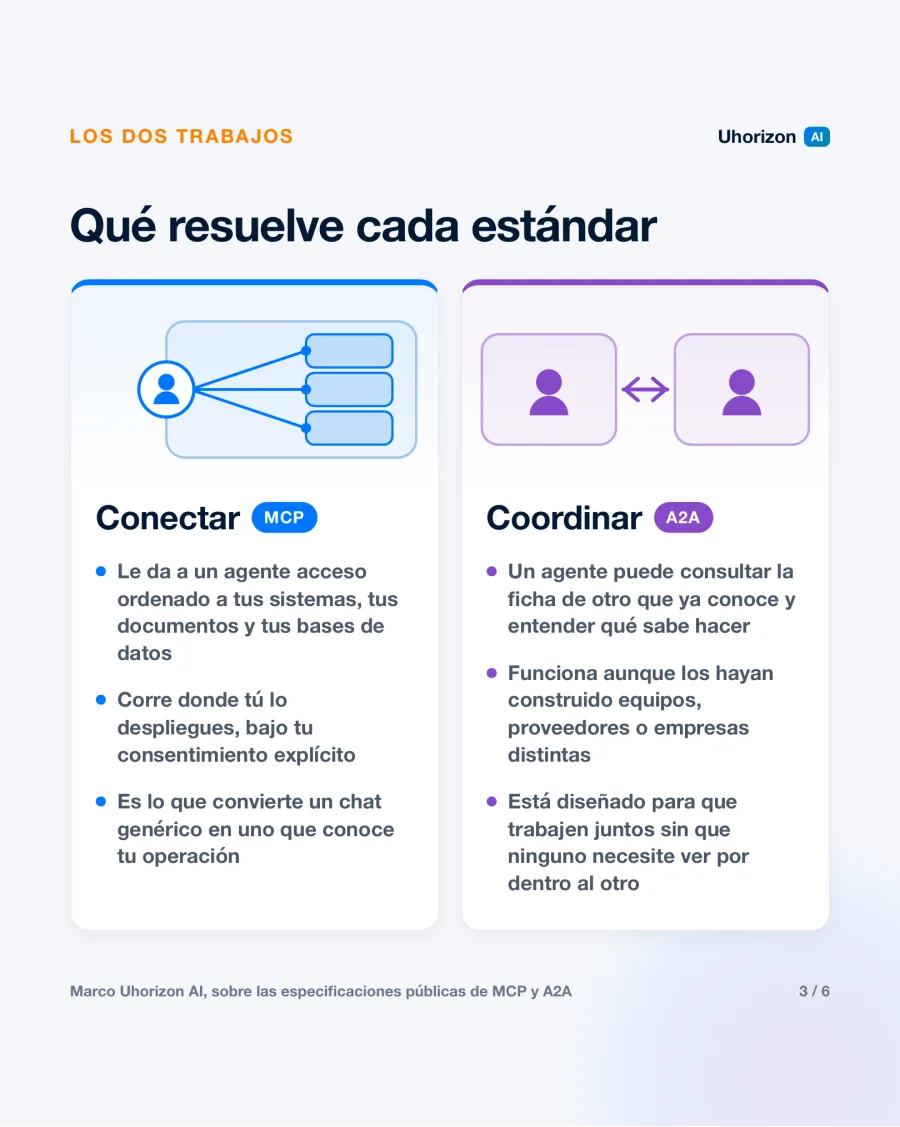
The A2A specification itself describes it this way: one agent asks another to do a task, and that second agent can use MCP to work with its tools and its data. The two standards complement each other.
Neither of them belongs today to the company that created it. Google donated A2A to the Linux Foundation, and Anthropic donated MCP to the Agentic AI Foundation, which is also part of the Linux Foundation. For a company that doesn't want to be locked into a single vendor, that matters.
Whether you need to coordinate agents depends on whether the work stays inside your department
The question that decides whether you need to coordinate agents is whether the work you want to solve stays inside your department, meaning your systems, your data and the people on your team.
- If the answer is yes, connecting one agent to your tools is enough, and you don't need to coordinate it with outside agents yet.
- If the answer is no, an agent you don't control comes into play: another department's, a vendor's or a customer's. That's where coordinating through a standard starts to make sense.
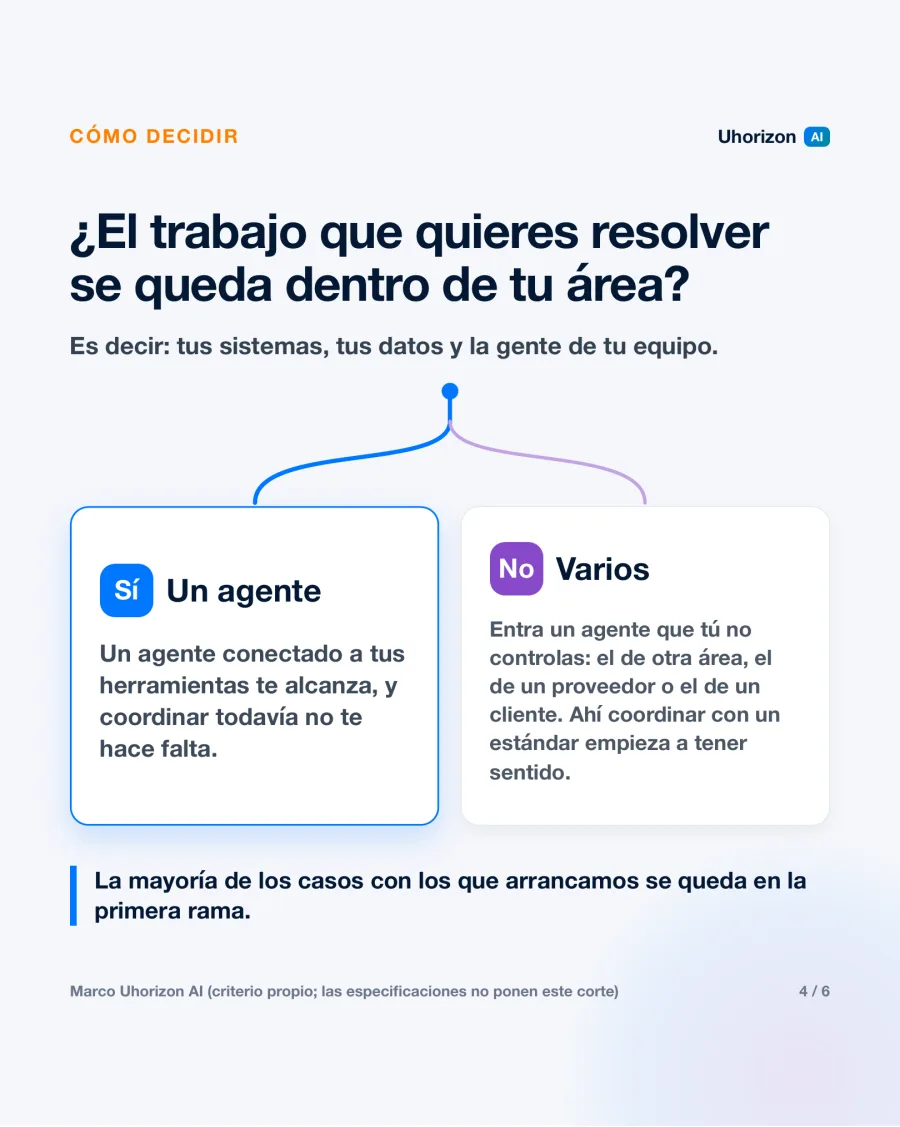
This dividing line is our own judgment, because the specifications don't draw it, and it comes from what we see when companies start: most cases stay on the first branch.
A few examples by department. In Finance, an agent that reconciles payments against the accounting system and the bank works with the department's own data, so connecting it is enough. In Customer service, one that answers from your own knowledge base also stays inside. In Procurement, on the other hand, an agent that negotiates terms with a vendor's agent is already talking to something you don't control, and that's where coordination enters the conversation.
Before approving the proposal, ask for three things
- That the first deliverable solves a complete process. One agent connected to the systems where that work lives, with a result your department can measure.
- That the connections are built on an open standard. That way you can switch vendors later without redoing what already works for you.
- That it's written down how coordination gets added later: what it would take on the day an agent from another department, a vendor or a customer comes in, and at what cost.
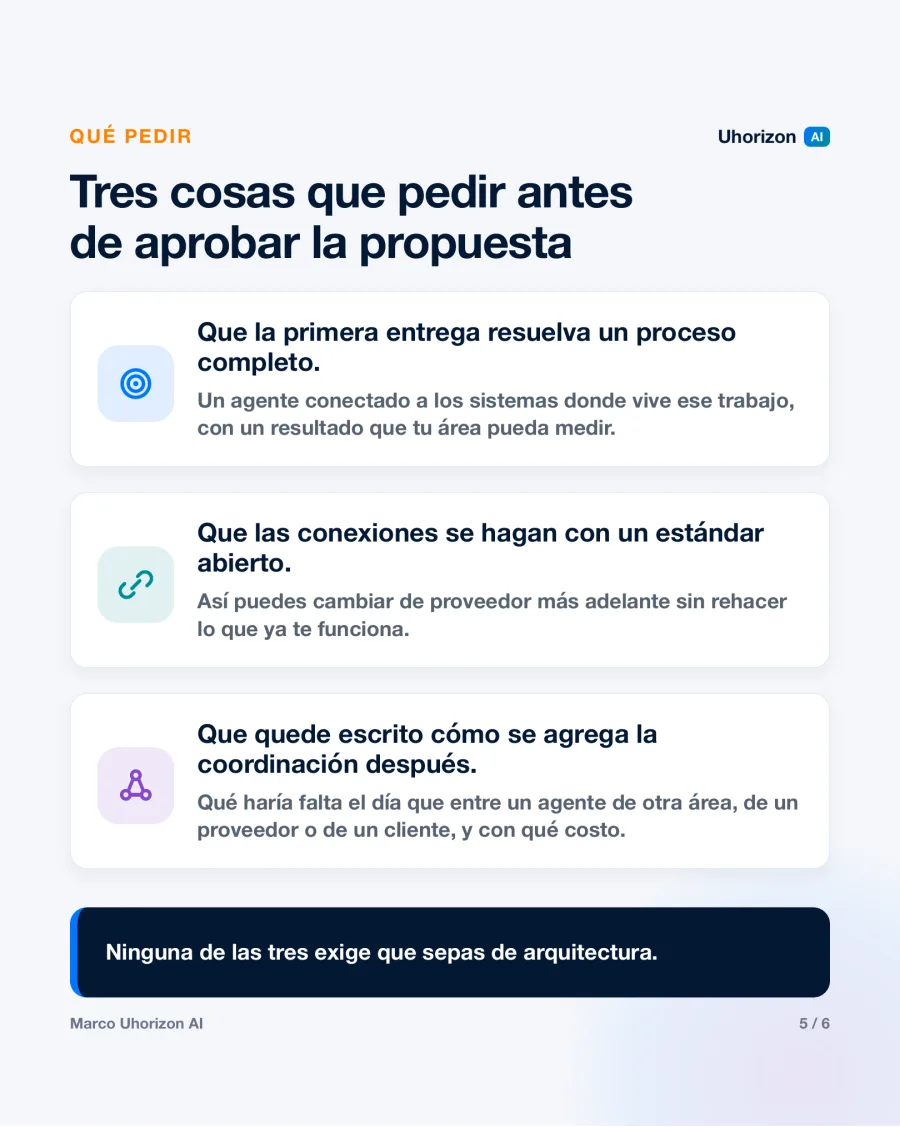
None of the three requires you to know about architecture. It's like building a single-story house with a second floor in mind: you don't need to build it today, but it's worth leaving the columns ready and keeping the blueprint.
What you can do on Monday: take the AI proposal you have on the table (or the idea you've been discussing with your team) and ask whether the work stays inside your department. If the work stays inside, ask for the first deliverable to be a single, well-connected agent with its result measured.
Connect first, coordinate later. One agent with standardized access to your operation solves most cases and lays the groundwork for whatever comes next. If you'd like to review your case or a proposal you've already received, let's talk for 30 minutes and choose where to begin.
Sources
- A2A specification, version 1.0.0, appendix on the relationship between A2A and MCP.
- MCP specification, Model Context Protocol.
- Linux Foundation, announcement of the Agentic AI Foundation, which receives MCP as a project contributed by Anthropic, December 2025.
- Linux Foundation, A2A Protocol Surpasses 150 Organizations, April 2026. A review of A2A's first year under the Linux Foundation.
- The department question and the three things to ask for in the proposal are Uhorizon AI's own judgment.