How to prove the return on an AI project from day one
In a KPMG survey, only 7% of large companies say they have proven ROI from AI. Which number to pick, when to measure it and who owns it.
Juan Miguel Jiménez P. · September 25, 2026 · 6 min read

If your CFO asked you tomorrow how much AI brought the company this year, what number would you give?
In the AI pilots we support, that question usually comes too late, when the project is over and nobody wrote down how the process looked before it started. And there's another question that takes even longer to get an answer: who owns the result once the pilot ends. This article is for the company whose AI projects aren't delivering results, and also for the company about to launch one and hoping to avoid the same fate.
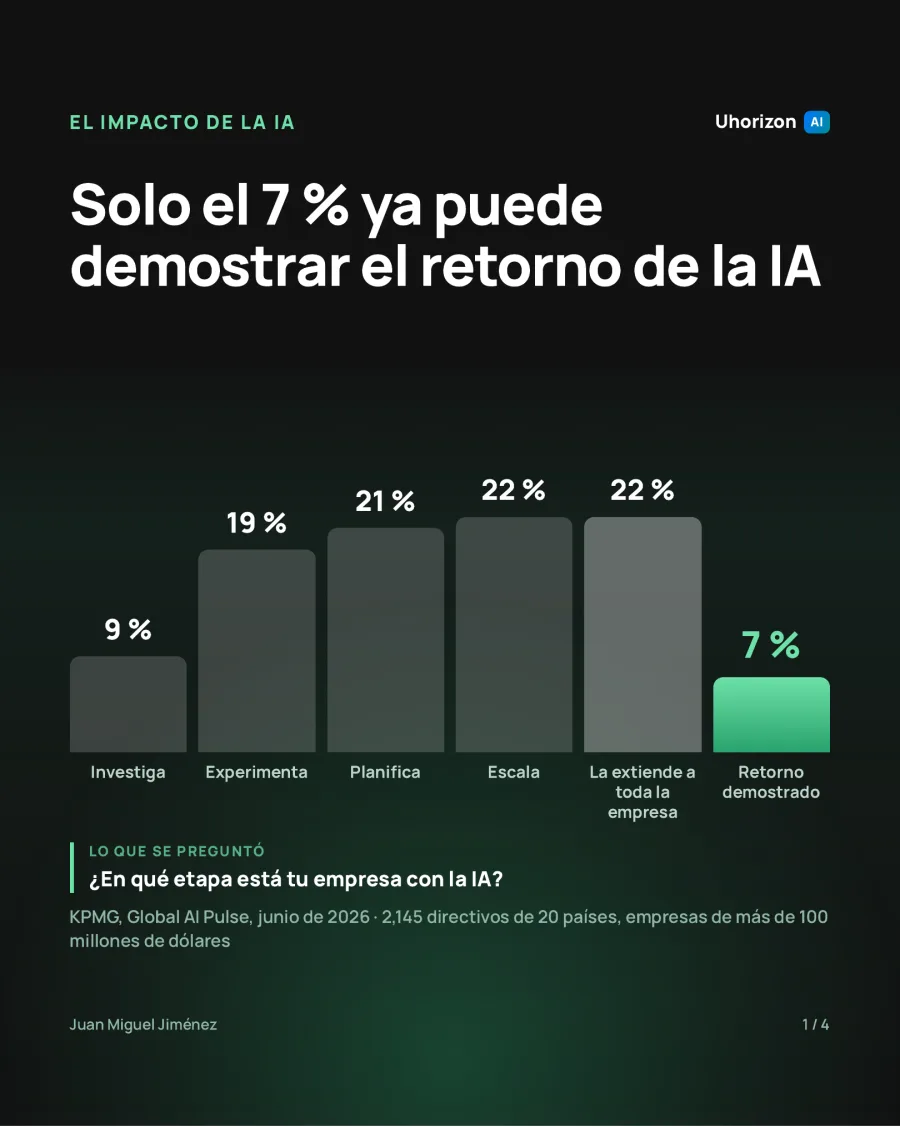
In a KPMG survey, only 7% of large companies say they have proven return from AI
Between April and May 2026, KPMG surveyed 2,145 executives in 20 countries, at companies with revenue of US$50 million or more (US$100 million in the United States, Canada and the United Kingdom). 22% say they are already scaling AI, and another 22% that they are extending it across the whole organization. And only 7% can say they have already established a proven return.
Accenture found something similar from another angle. In its July 2026 survey of 3,000 executives, the share seeing broad, sustained results from AI dropped from 32% at the start of the year to 23% in July 2026, even though 82% increased their investment.
Be careful about reading these numbers as a reason to hit the brakes. If you don't yet know which number is going to change, experiment anyway, because testing is how you find it. What's worth avoiding is turning that experiment into a project before you have the number.
Return is proven with a business number
AI adds value in two ways. It improves what the company already does: less rework, fewer hours on repetitive tasks, more work done right the first time. And it opens up what the company couldn't do before: reviewing every case instead of a sample, responding after hours, reading information nobody had time to read.
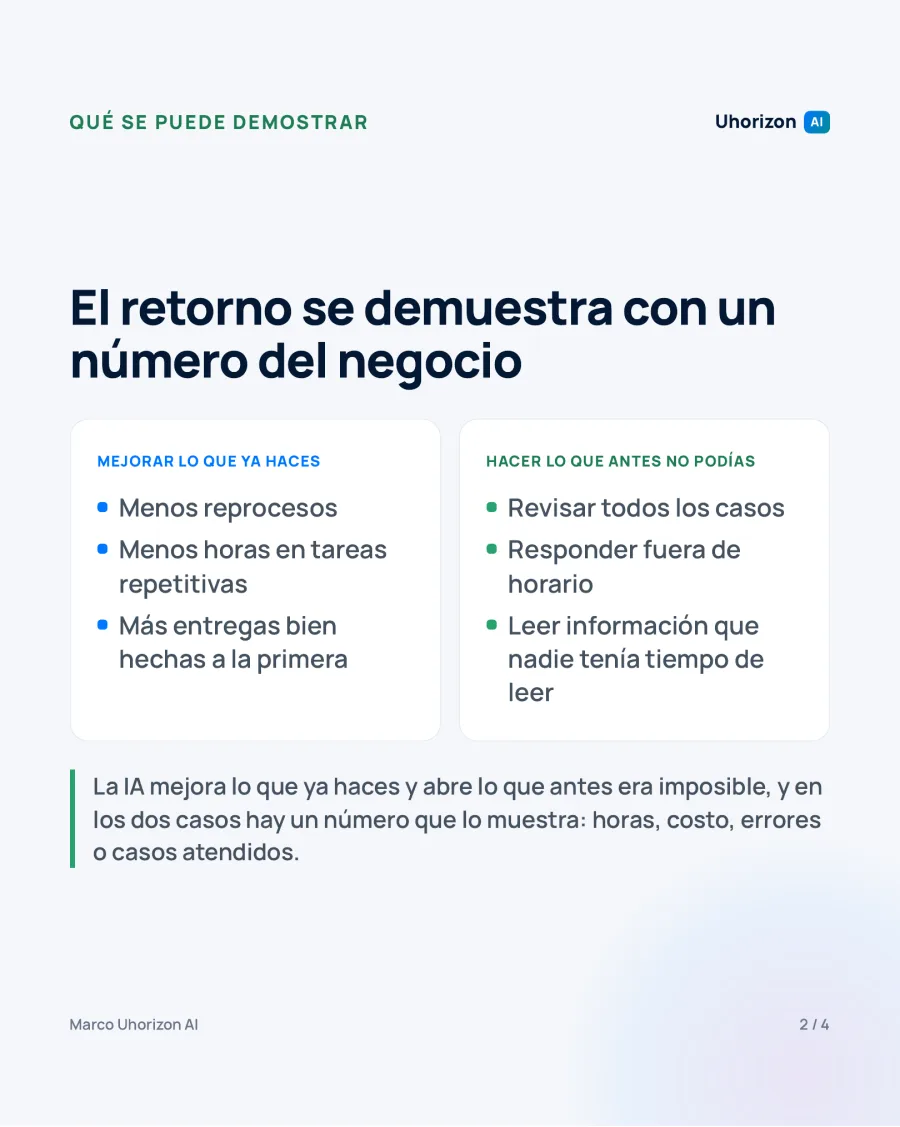
In both cases there's a number that shows it, and it's almost always one of four: hours, cost, errors or cases handled. Many vendor tools measure the agent's consumption, cost and response time by default. That data helps you run the tool and says little about whether the department is working better.
A few examples of what that number looks like in each department:
- Finance. The percentage of invoices sent back because of an error.
- Customer service. Cases resolved on first contact.
- Sales. The hours it takes to prepare a proposal.
- Operations. Orders that get corrected by hand before they ship.
The baseline is measured before the agent starts operating
Proving impact takes three steps, and the order matters:
- Evaluate the possible use cases and pick the one with the highest impact. That's what lowers the risk of the project failing the most.
- Measure the baseline before the agent starts operating, because afterward the process changes and that data can't be recovered.
- Measure again when the pilot ends and compare. With the start and the end you see the trend and how much more impact you can get.
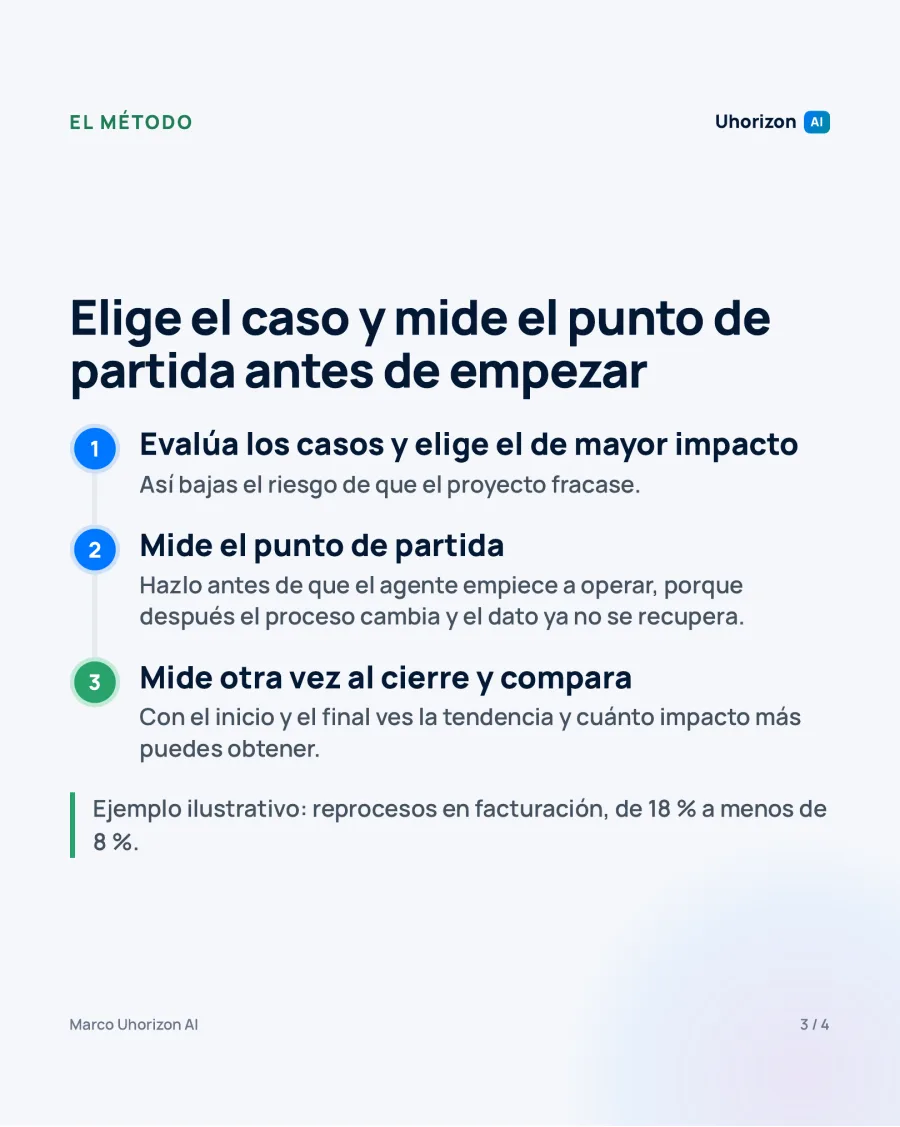
As an illustration, if rework in invoicing is at 18% today and the goal is to bring it below 8%, that 18% has to be captured before you start. Measured a month later, with the agent already operating, the baseline is gone. It's like weighing yourself only after three weeks on a diet: you know you lost weight, but not how much.
Without a number that changes, there's no AI project yet.
Companies with a clear owner say they get more value from AI
The same KPMG survey compares companies where it's clear who is accountable for the decisions made with AI, especially when that accountability sits with the CEO, against those where it isn't clear. In the first group, 57% say they are getting real value from AI. In the second, 21%. It's a measured association, and the survey doesn't claim that the owner causes the value, but the gap is wide.
Being accountable for AI has two parts:
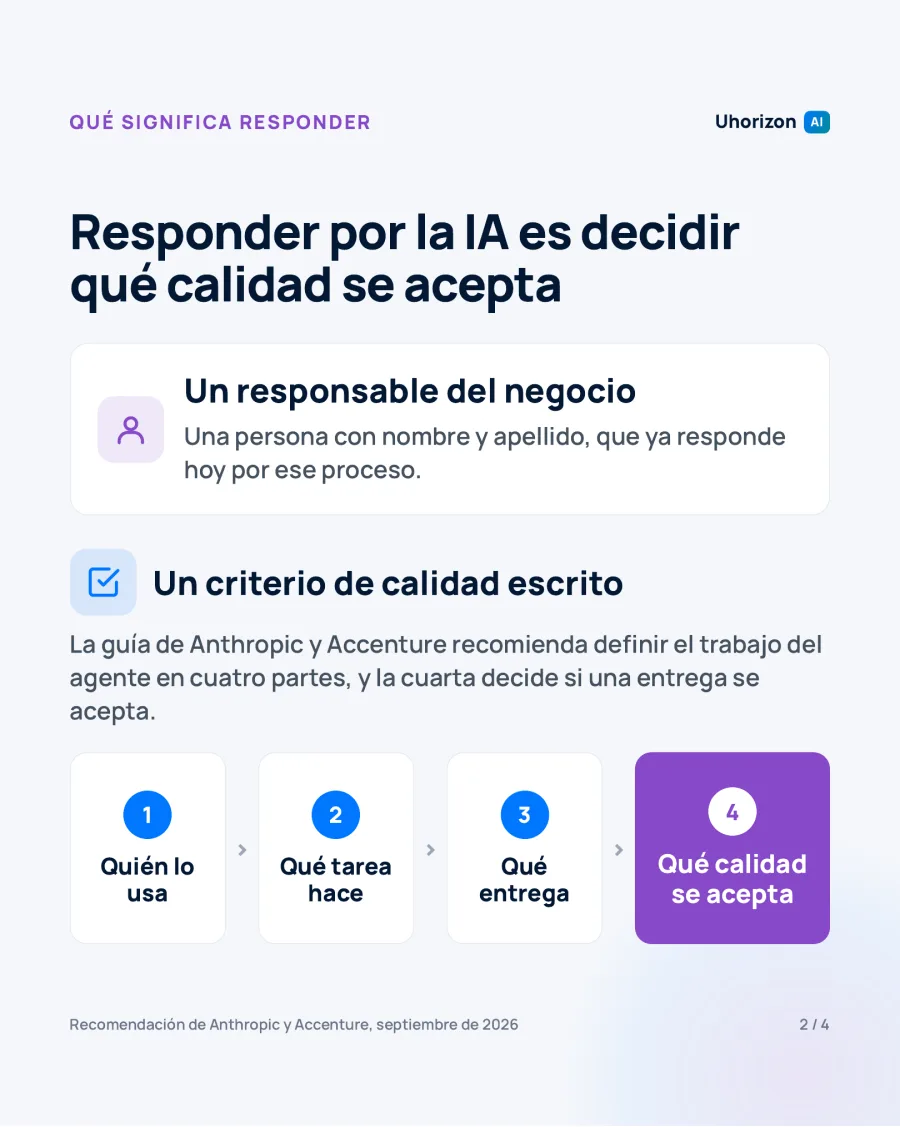
- A business owner. A named person who is already accountable for that process today.
- A written quality standard. The guide that Anthropic and Accenture published in September 2026 recommends defining the agent's work in four parts: who uses it, what task it does, what it delivers and what quality is acceptable. The fourth is the one that decides whether a deliverable passes.
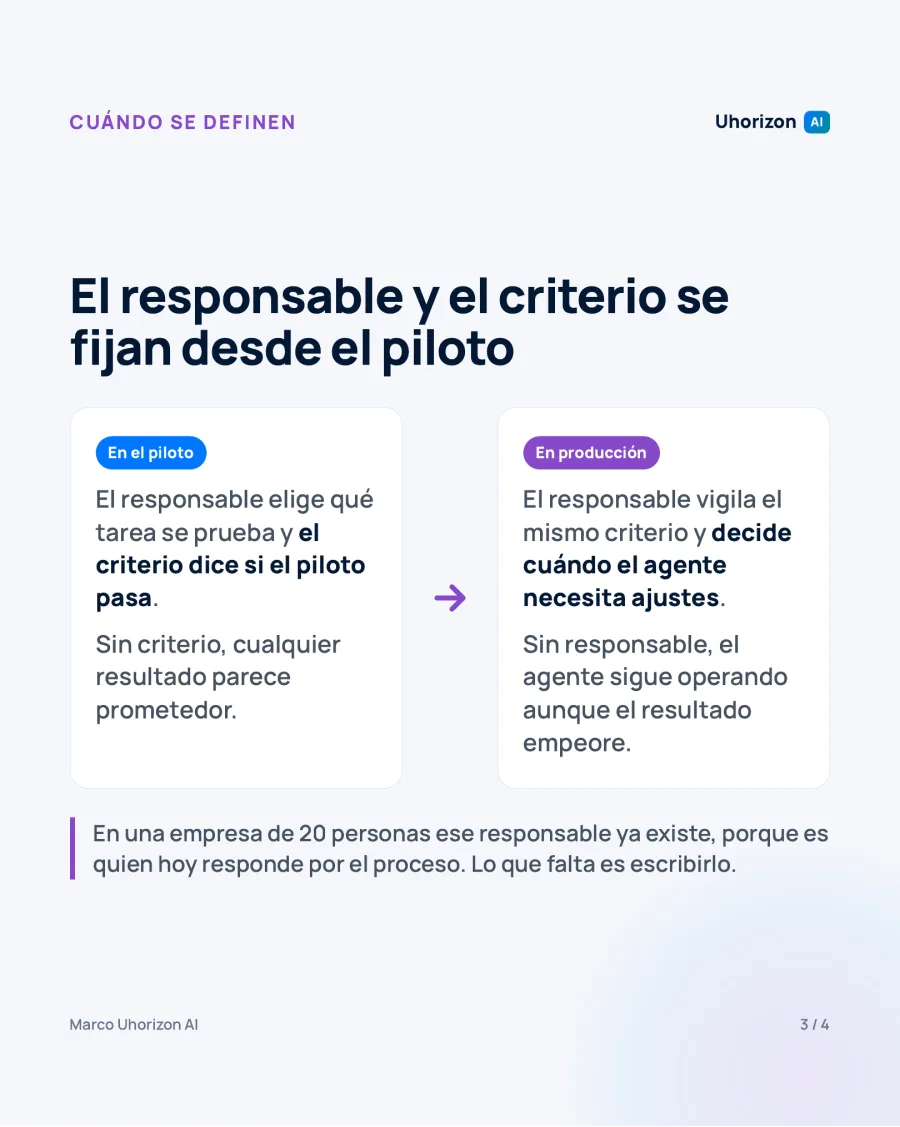
The owner and the standard are set from the pilot onward
In the pilot, the owner chooses which task gets tested and the standard says whether the pilot passes. Without a standard, any result looks promising. In production, the owner watches that same standard and decides when the agent needs adjustments. Without an owner, the agent keeps operating even as the result gets worse.
In a small company that owner almost always already exists, because it's whoever is accountable for the process today. What's missing is writing it down.
With any pilot you have running, you can do three things this week: write down the name of the person who owns it, write down what quality they accept and record today's number for the process you want to improve. Defining all of this with the department, task by task, takes work, and it's the first thing we do with every company we support.
Back to your CFO's question: next time, the answer can be a number with a date, compared against another number with a date, with a person who owns it. If you're about to decide where to use AI, or you have a pilot that isn't quite showing results, let's talk for 30 minutes and choose together the case with the most impact in your company.
Sources
- KPMG, Global AI Pulse, Q2 2026, June 24, 2026. Survey of 2,145 executives in 20 countries at companies with US$50 million or more in revenue (US$100 million in the United States, Canada and the United Kingdom), with fieldwork from April 28 to May 25, 2026. KPMG also offers AI consulting.
- Accenture, Pulse of Change, July 2026. Survey of 3,000 executives.
- Anthropic and Accenture, Deploying AI from pilot to production, September 14, 2026.
- The three steps for measuring impact and the owner's role in the pilot and in production are Uhorizon AI's own method.