How to measure the time your team spends reviewing AI output
The real savings from AI are what's left after you subtract review time. Four numbers to measure it and three steps to focus review where it matters.
Juan Miguel Jiménez P. · October 19, 2026 · 5 min read
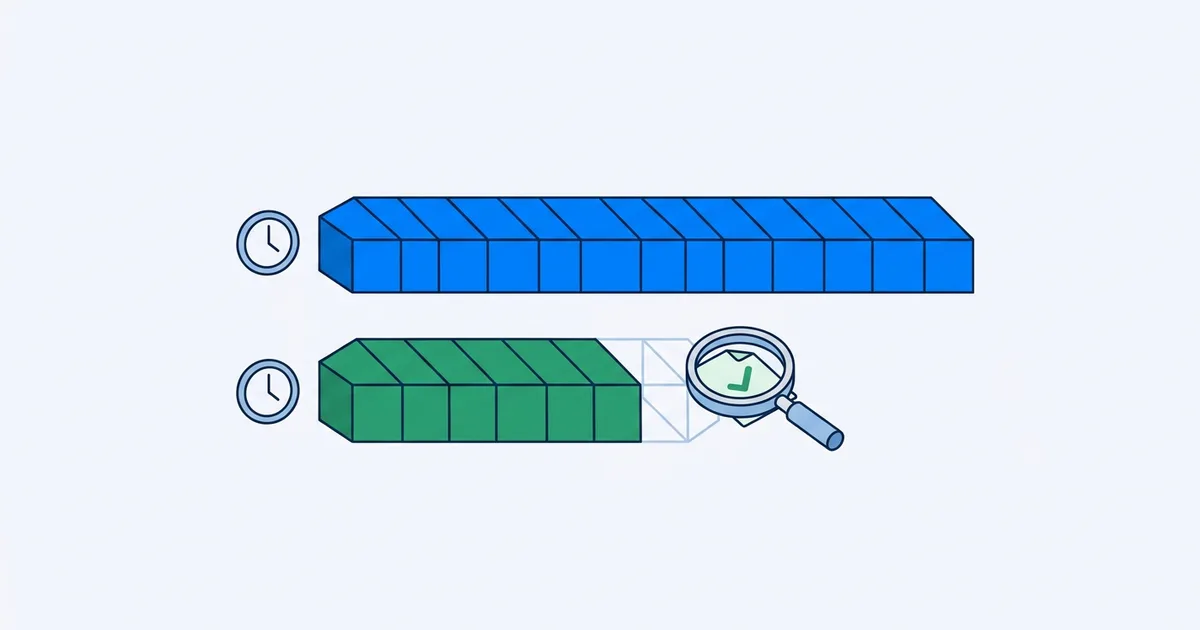
Every time a company brings in a new tool, the first thing it measures is how much time it saves. AI is no different: you measure how long the task takes with AI, compare it with how long it used to take, and present the difference as the pilot's result. That measurement rarely includes the time someone then spends reviewing and correcting what the AI produced.
This article is for the department head who is about to launch a first pilot, or who already has one running and feels the promised savings aren't showing up in the team's week. It covers what to measure in the baseline and how to decide where a person reviews everything and where less is enough.
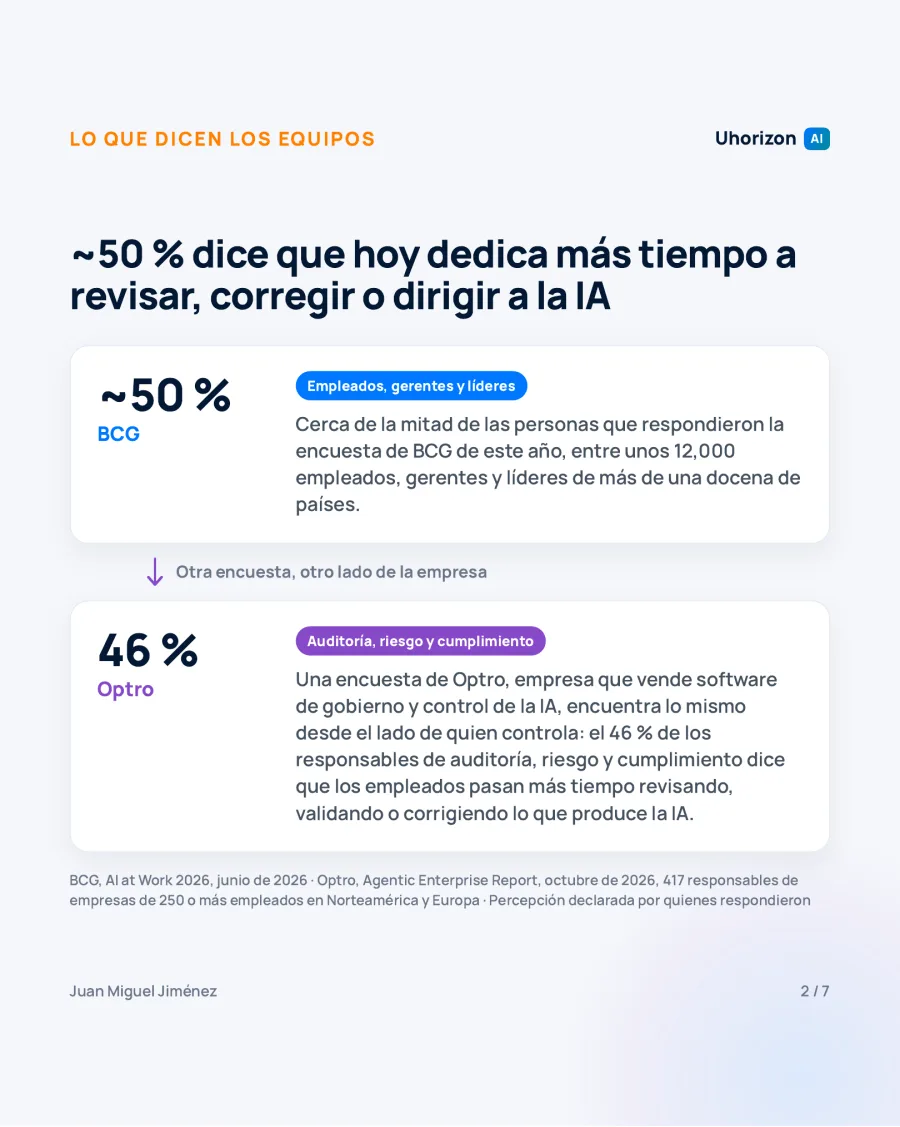
~50% say they now spend more time reviewing, correcting or directing AI
Close to half of the people who answered BCG's survey this year, among roughly 12,000 frontline employees, managers and leaders in more than a dozen countries, say they now spend more time reviewing and correcting AI output, or managing and directing AI. It's self-reported, so it works as a signal of what people experience at work. The hours are something each company measures in its own pilot.
A survey by Optro, a company that sells governance, risk and compliance software, reaches the same point from the control side. Of 417 audit, risk, compliance and security leaders at companies with 250 or more employees in North America and Europe, 46% say employees are spending more time reviewing, validating or correcting AI outputs.
A pilot that only measures what the task saves leaves out review time
Think of a new intern joining the team. They draft fast and deliver on time, but someone more experienced reviews and corrects every piece before it goes out. If you only measure what the intern drafted, the team looks more productive than it is, because the reviewer's time shows up nowhere.
The same thing happens with AI, and the review falls on someone who knows the process well, because that's the person who can spot the mistake. The time that goes into reviewing comes out of the people with the best judgment on the team.
The pilot baseline needs four numbers per task
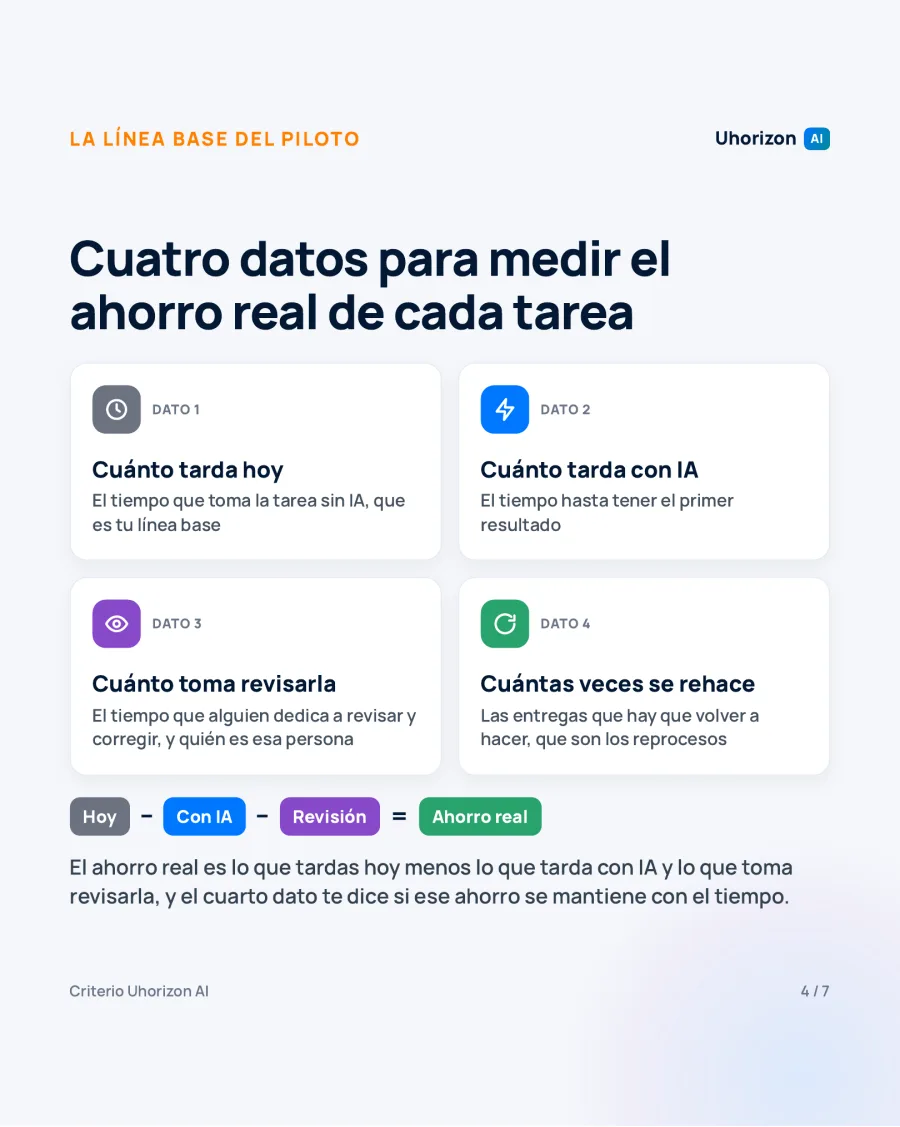
The baseline is a measurement of how the task works today, before the agent starts operating, and it's the only way to say later how much changed. To include review, we recommend measuring four numbers for every task in the pilot:
- How long it takes today. The time the task takes without AI.
- How long it takes with AI. The time until the first result is ready.
- How long review takes. The time someone spends reviewing and correcting, and who that person is.
- How often it gets redone. The deliverables that have to be done again, which is your rework.
The real savings are what it takes today minus what it takes with AI and the time review takes. The fourth number tells you whether those savings hold over time: if more deliverables have to be redone every week, the first week's savings won't repeat. This is a measurement approach we use at Uhorizon, and we present it as our own criterion.
Almost everyone believes processes should adapt, and very few have redesigned them
In the same Optro survey, 96% of leaders agree that workflows should adapt to work with agents, and only 9% have redesigned them.
For us, the most important thing is to review the business process, optimize it and turn it into an agentic process, so the person and the reviews end up in the right place. It's how we work with our clients, and we present it as our own criterion, because the survey only measures the gap between what people believe and what they've done.
Review and the person belong where a mistake costs the most
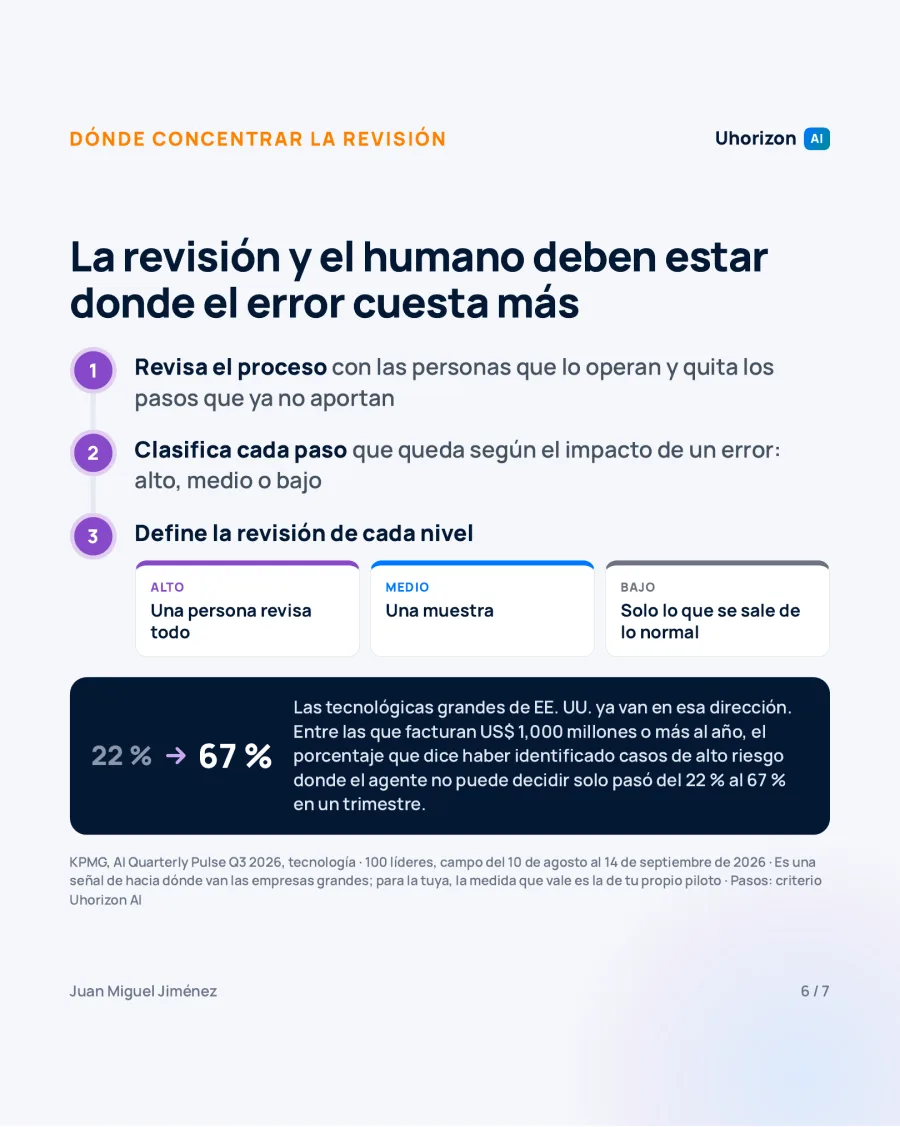
If everything the AI produces gets reviewed with the same care, the savings can disappear. What we recommend is deciding how much review each step needs before the agent starts operating, in three steps:
- Review the process with the people who run it and remove the steps that no longer add value.
- Rank each remaining step by the impact of a mistake: high, medium or low.
- Set the review for each level. A person reviews everything at high, a sample at medium, and only what looks out of the ordinary at low.
An illustrative example in finance: a reconciliation that ends in a vendor payment goes to high and a person reviews it end to end; the weekly accounts receivable summary goes to medium and gets a sample review; sorting incoming email goes to low and only gets a look when something doesn't fit.
Large companies are already moving in that direction. In KPMG's quarterly survey of 100 leaders at U.S. technology companies with US$ 1 billion or more in annual revenue, the share that say they have identified high-risk use cases where an agent can't decide on its own rose from 22% to 67% between the second and third quarters of 2026. It's a sample of large companies and works as a signal of where things are heading; for your company, the measure that counts is the one from your own pilot.
Sources
- BCG, AI at Work 2026: Why Strategy Matters More Than Tools, June 2026.
- Optro, Agentic Enterprise Report, October 2026. Optro is a governance, risk and compliance software vendor.
- KPMG, AI Quarterly Pulse Survey Q3 2026, technology, October 2026. Fielded from August 10 to September 14, 2026.
The real savings from AI are what's left after you subtract review time, and that time is measured from the baseline. If you're about to launch a pilot, let's talk for 30 minutes and pick together which tasks to measure first.