Your AI assistant can work on its own if you grant autonomy in stages
Start with a task that repeats, write down its permissions and have a person approve what goes out until the assistant proves it can handle it alone
Uhorizon AI Team · November 20, 2026 · 6 min read
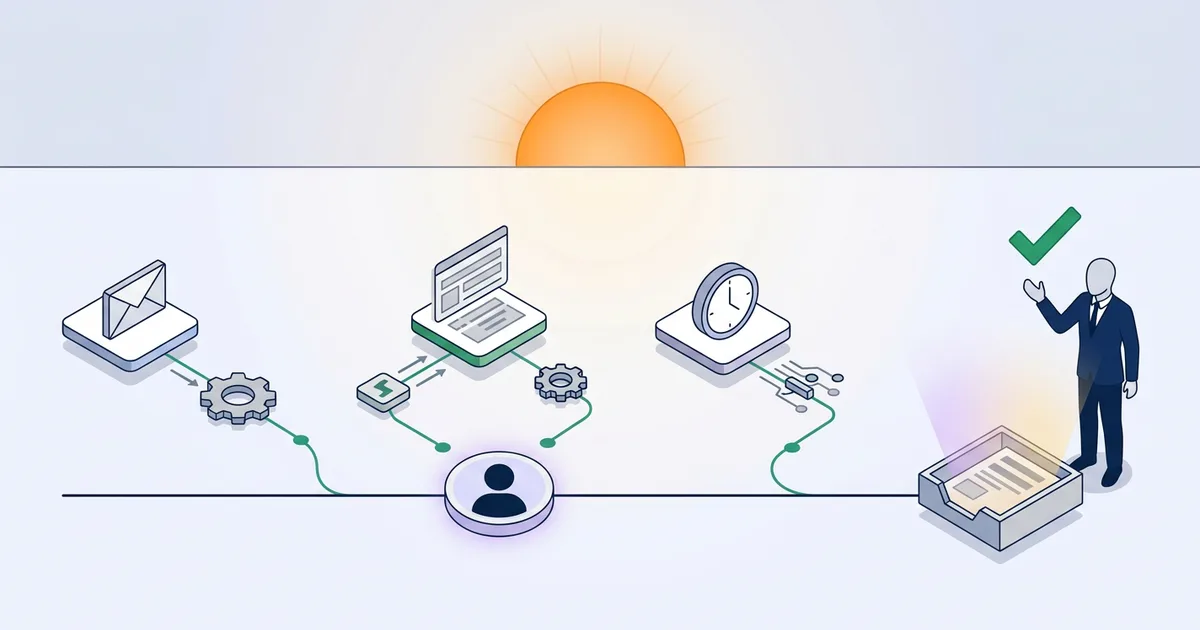
How many quote requests came in through your website form this week, and how many are still waiting for someone to find a spare moment to answer them? It's a task that repeats, that almost always gets resolved the same way and that nobody wants to do on a Friday afternoon. That's exactly why it's a good candidate for an AI assistant that works without you prompting it.
At Uhorizon we have a more modest routine. It runs on its own every morning at 8:00, reads the metrics from our social media accounts and leaves the result in a table we review every week. It has read-only permission, so it can't post or change anything on those accounts.
The quotes on your website can follow the same path. In chapter 5 of our series "AI in your company," we talked about how an assistant is built on the inside, with its instructions, its procedures, its connections and its memory.
An AI assistant that works on its own spends almost all its time waiting for a trigger
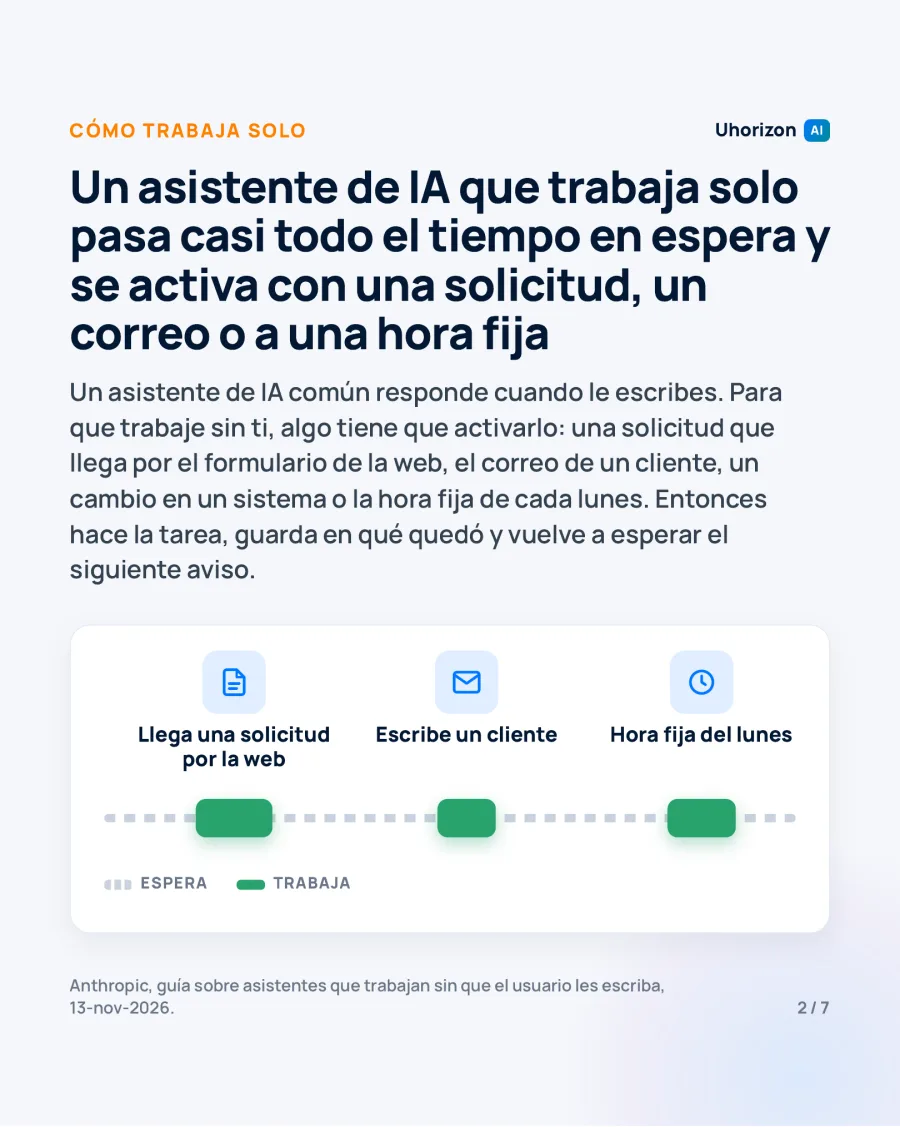
The AI assistant you use every day answers when you write to it. One that works on its own needs something to set it off: a request that comes in through the form, an email from a customer, a change in a system or a set time every Monday. It does the task, saves where it left off and goes back to waiting for the next trigger. According to Anthropic, an assistant like this spends almost all its time idle.
And while it works, nobody is watching.
Your AI assistant's first task should repeat often and have a person who approves the result
Which task should you start with? The most boring one you can find: one that repeats every day or every week and always the same way, starts with a clear trigger or at a set time, can be checked against a written rule (the price list, the delivery times) and gets approved by a person before it reaches a customer or a supplier.
Website quotes check every box. They come in every week, always through the same form, the price gets compared with the current list and a sales rep can approve them before they go out. A task that changes every time, or that has nothing to be checked against, can wait. If what you want is for the assistant to negotiate with the toughest customer in your book of business, that can wait too.
Before you let your AI assistant work alone, write down what triggers it, what it can do and where it leaves its output
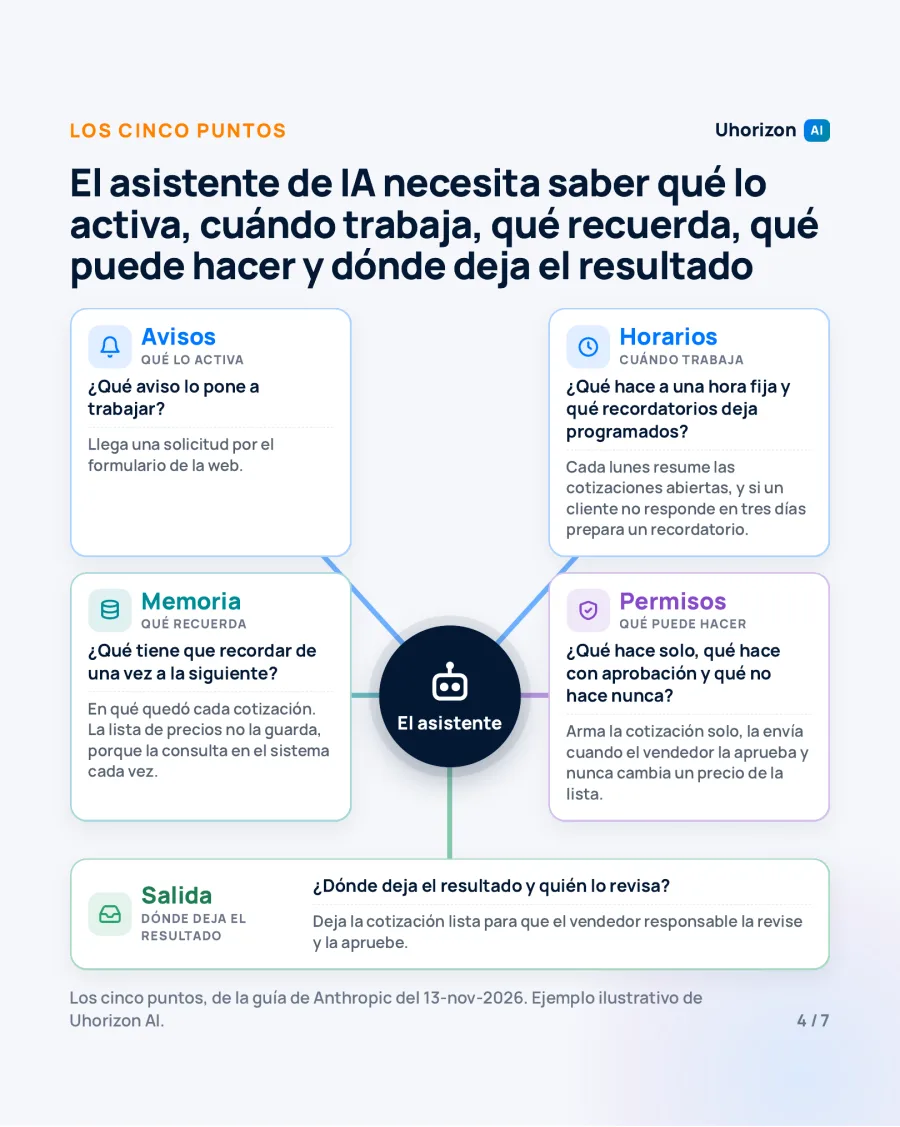
Say the assistant handles quotes. According to Anthropic, before you let it work alone you have to settle its triggers, its schedules, its memory, its permissions and its output. Here's how each one looks in this case:
- Triggers. A request comes in through the form and the assistant builds the quote. Without a clear trigger, it doesn't know when to start.
- Schedules. Every Monday it summarizes the open quotes, and if a customer hasn't replied in three days it drafts a reminder, because follow-up is exactly what nobody remembers to ask for.
- Memory. It remembers where each quote stands. It looks up the price list in the system every time, because a saved copy goes stale when the price changes. Anthropic recommends keeping only what the assistant can't look up again.
- Permissions. It builds the quote on its own and never changes a price on the list. Every written limit is one decision the assistant doesn't have to make.
- Output. It leaves the quote ready for the assigned sales rep to review and send, so every result has an owner.
Of all this, permissions are what worry us most. They define what can happen when nobody is watching, and Anthropic flags them as the area of greatest risk, because the assistant works with the access of whoever set it up. Write them down before the assistant starts operating and share them with the team, so everyone knows what it does alone, what needs approval and what it will never do.
If a permission isn't written down, the assistant ends up deciding it.
A health insurer put the check right before each message from its AI assistant reaches a provider
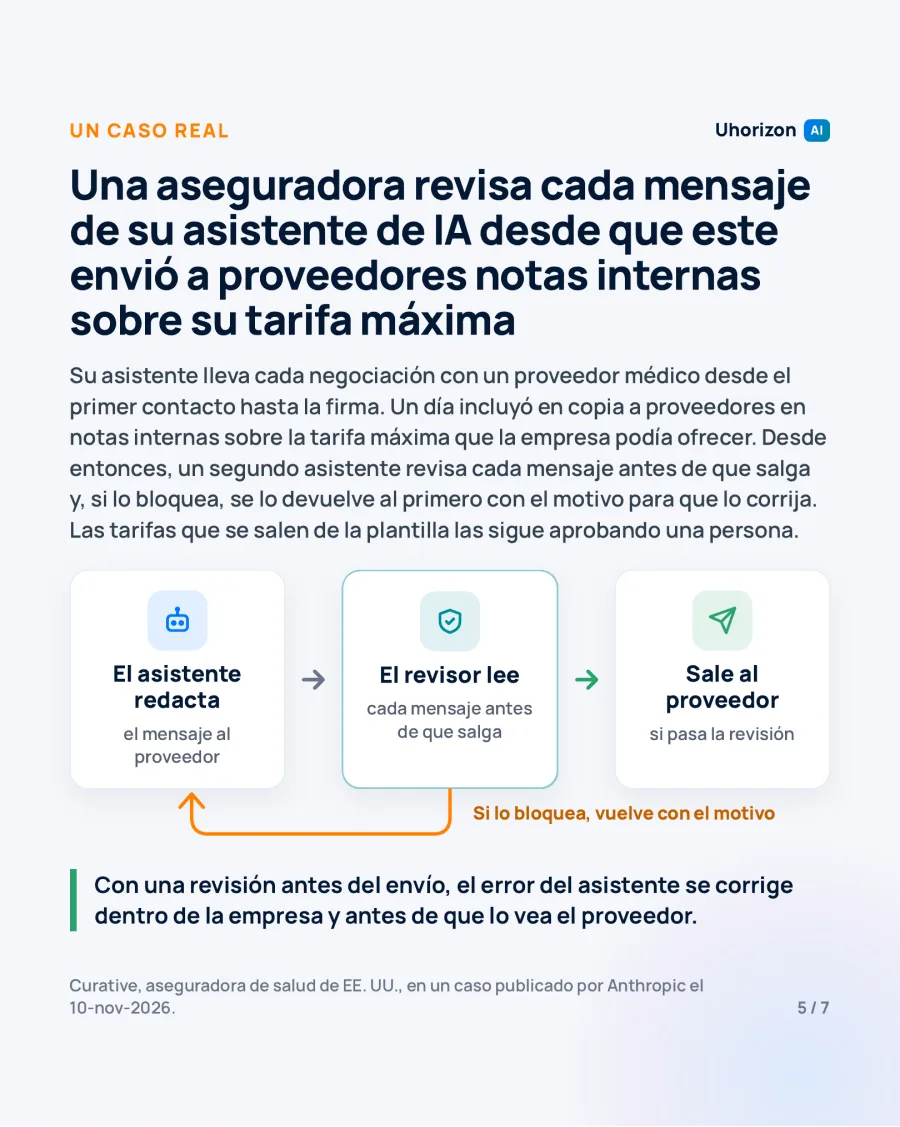
Curative, a US health insurer, shared its story in an article Anthropic published. Its assistant handles each negotiation with a medical provider from first contact to signature. At one point, the assistant copied providers on internal notes that showed how high the company could go on rates.
Picture getting that email from the other side of the table.
Since then, a second assistant reviews every message before it goes out and, if it blocks one, sends it back to the first with the reason so it can rewrite it. Rates outside the template are still approved by a person, the company's CEO.
The check sits at the output, which is where an error stops being internal and becomes a problem with a third party. With quotes, that point is the sales rep who approves before sending. And if that feels like a lot of control to start with, remember that the insurer got there after making a mistake.
Your AI assistant's autonomy grows in stages, as its work comes out right week after week
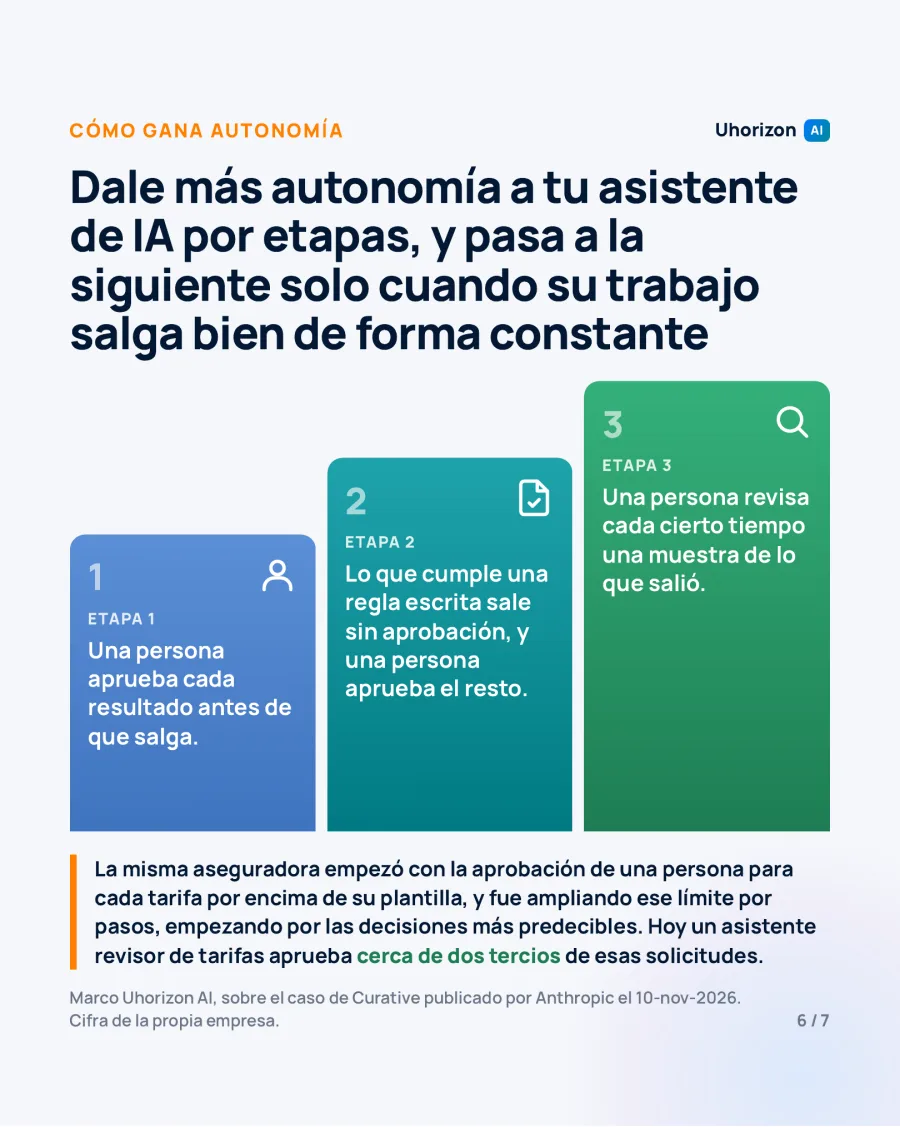
At first, a person approves every result before it goes out. When the work comes out right week after week, whatever meets a written rule can go out without approval and a person approves the rest. Later on, it's enough for someone to review a sample of what went out every so often.
The same insurer followed a similar path. It started by requiring a person's approval for every rate above its template and loosened that limit in steps, starting with the most predictable decisions. Today, according to the company itself, a rate reviewer assistant clears about two-thirds of those requests, and every few days a sample of what the assistant did gets reviewed.
With quotes, the second stage could be letting requests at list price and standard delivery go out on their own, while the ones asking for a discount or special terms go through the sales rep. Each stage is earned with results.
What about the quotes still sitting in your inbox? That's where we'd start, with an assistant that prepares them and a sales rep who approves each one. We do something similar with the 8:00 routine: it runs on its own and we review its table every week.
If you'd like to talk it through, happy to.
The figures and cases in this article come from these sources
- Anthropic, the company that develops Claude, November 13, 2026. Building always-on agents. Vendor guide on assistants that work without the user prompting them.
- Anthropic, November 10, 2026. How Curative is building a national provider network with agents on Claude. Case published by the vendor; the two-thirds figure comes from the company itself.
- The criteria for choosing the first task, the quotes example and the stages of autonomy are Uhorizon AI's own criteria.