How much autonomy to give an AI agent in each process
Between locking an agent down and giving it free rein there are three levels of human control. How to pick one for each process, with three questions.
Juan Miguel Jiménez P. · August 3, 2026 · 6 min read

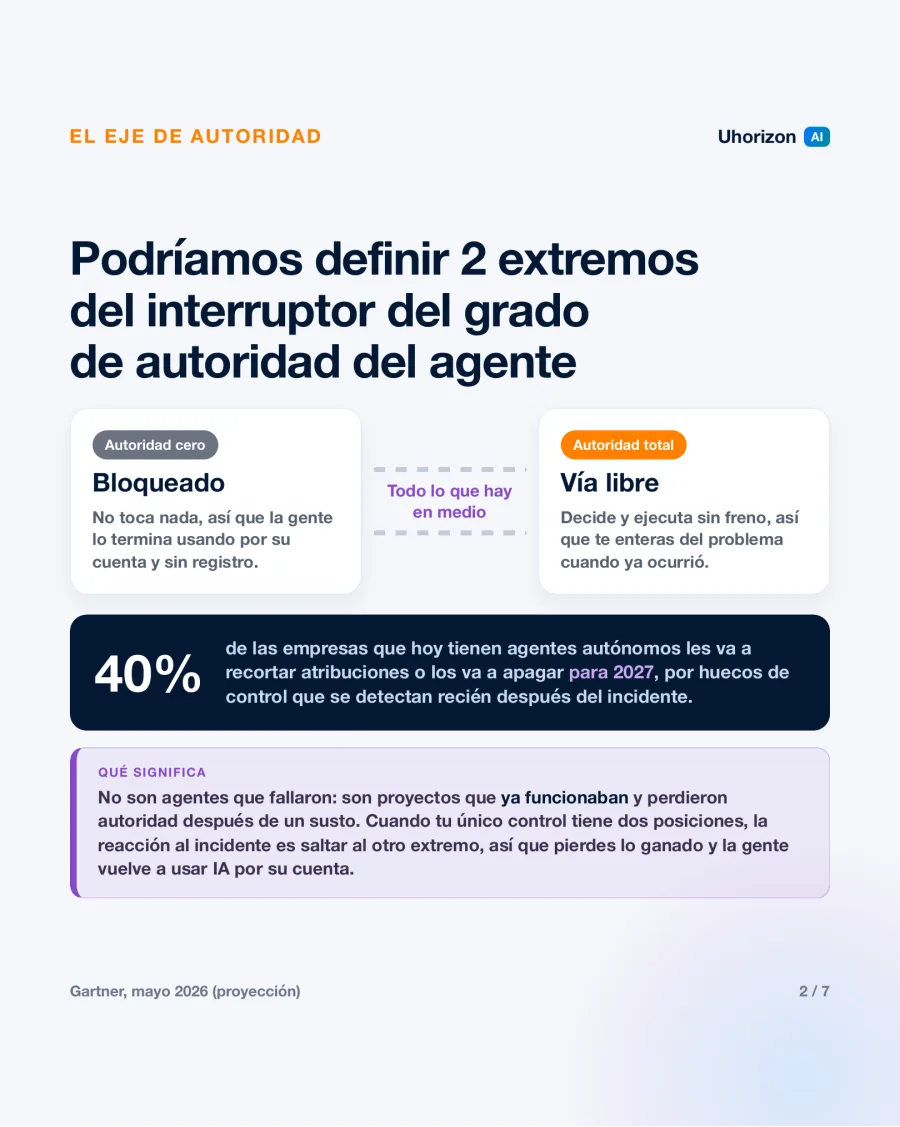
When a company decides what to do with an AI agent, it almost always ends up facing a switch with two positions: either the agent can't touch anything, or it gets free rein. Both options are expensive. Locking it down leaves people without the tool, and free rein means you find out about the problem after it has already happened.
Has your company been through either one? This article is mainly for the company that is already seeing results with AI and now needs to govern it in order to scale, although the questions at the end are useful from the very first agent.
A two-position control ends up stripping the agent of its authority
In May 2026, Gartner projected that by 2027, 40% of the companies that run autonomous agents today will cut back their authority or shut them down, because of control gaps that only get detected after an incident. What strikes me most about that figure is the kind of project it describes: agents that were already working and lost their authority after a scare.
Gartner also names the cause, which is treating agent governance as binary, either locked down or fully trusted. When your only control has two positions, the natural reaction to an incident is to jump to the other extreme. You lose what you had gained, and people go back to using AI on their own.
Between the two extremes there are three useful levels
- Prior approval (human-in-the-loop). Nothing happens without the person's approval. It is the most expensive in time, and the only one that prevents the damage before it happens.
- Right to intervene (human-on-the-loop). The agent moves forward on its own and the person monitors, with the power to stop it or roll it back. It only works if the action can actually be undone.
- Autonomy within limits (human-out-of-the-loop). The agent decides within defined limits, and the person reviews results and exceptions instead of reviewing every case.
Each level delegates more authority to the agent and asks less time of the person. It looks a lot like delegating within a team. You review everything an intern does before it goes out, you let the analyst with a year in the role move ahead and correct them when needed, and you ask the department head to report the exceptions. Nobody would say one of those three arrangements is right for everything, because it depends on the person and the task.
Each level applies at the input, during the work or at the output
Everything here is decided process by process. Each of the three levels can apply at three different moments, which gives you a nine-cell matrix:
- At the input. With prior approval, you authorize which cases the agent can take. With the right to intervene, you see the request and can discard it. With autonomy within limits, the agent only takes cases that fall inside what was defined.
- During the work. With prior approval, it stops at the risky step and waits for your approval. With the right to intervene, you follow the execution and can stop it. With autonomy within limits, it moves ahead without checking with you and halts when it reaches the limit.
- At the output. With prior approval, nothing is delivered without your sign-off. With the right to intervene, you review what was done and can roll it back. With autonomy within limits, you review samples and exceptions.
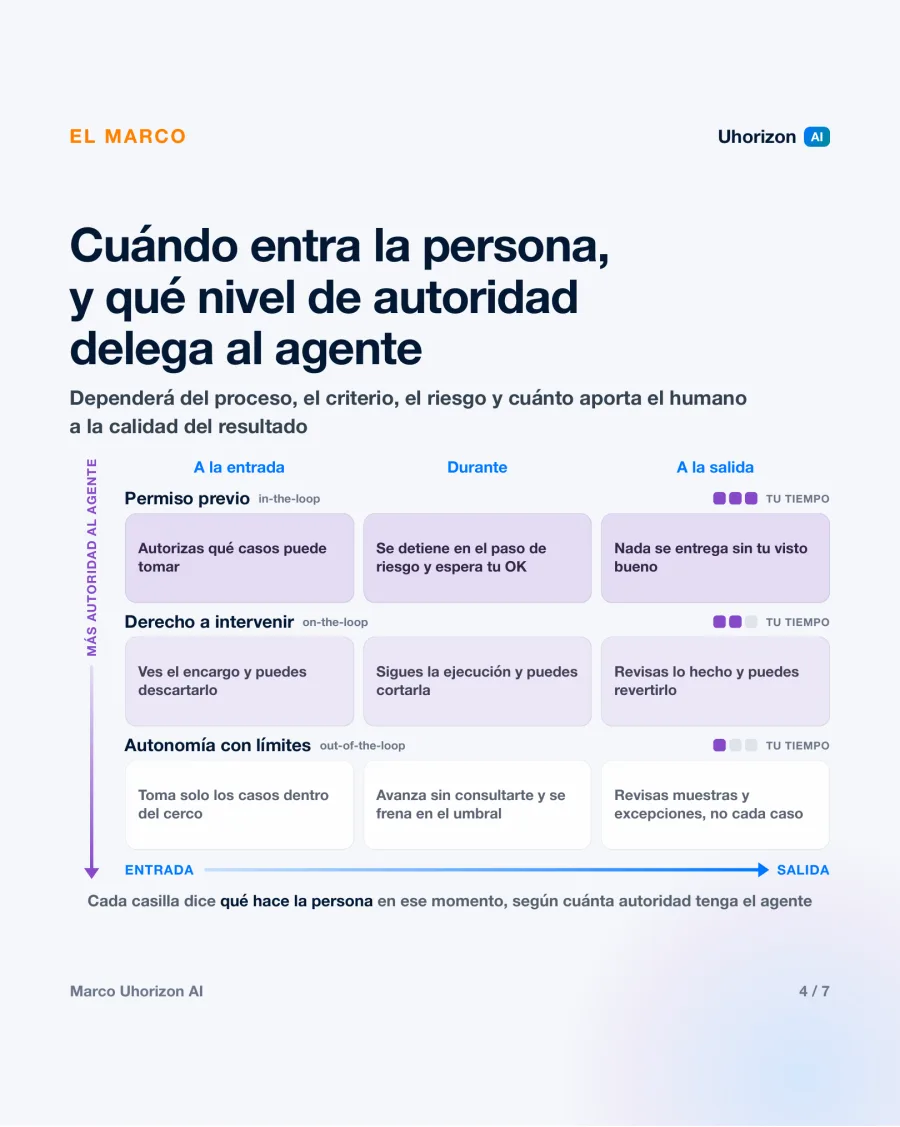
The level and the moment that suit you depend on the process, the judgment it requires, the risk and how much the person adds to the quality of the result. A few examples by department:
- Finance. An agent that prepares vendor payments asks for prior approval at the output: no payment goes out without a signature.
- Customer service. One that answers frequent questions can have autonomy within limits during the process, with a person reviewing samples every week.
- Sales. One that updates customer account information fits the right to intervene at the output, because a data entry error gets fixed at little cost.
Gartner frames something similar from the agent's side, with four forms of autonomy: observe, advise, act with approval and act alone. Observe falls outside the matrix because it only reads, advise matches prior approval at the output, act with approval matches prior approval during the process, and act alone matches autonomy within limits with exception review. Gartner also separates two things worth looking at one by one: what an agent can do, and what it has access to. An agent that only advises can still be reading your entire customer base without needing to.
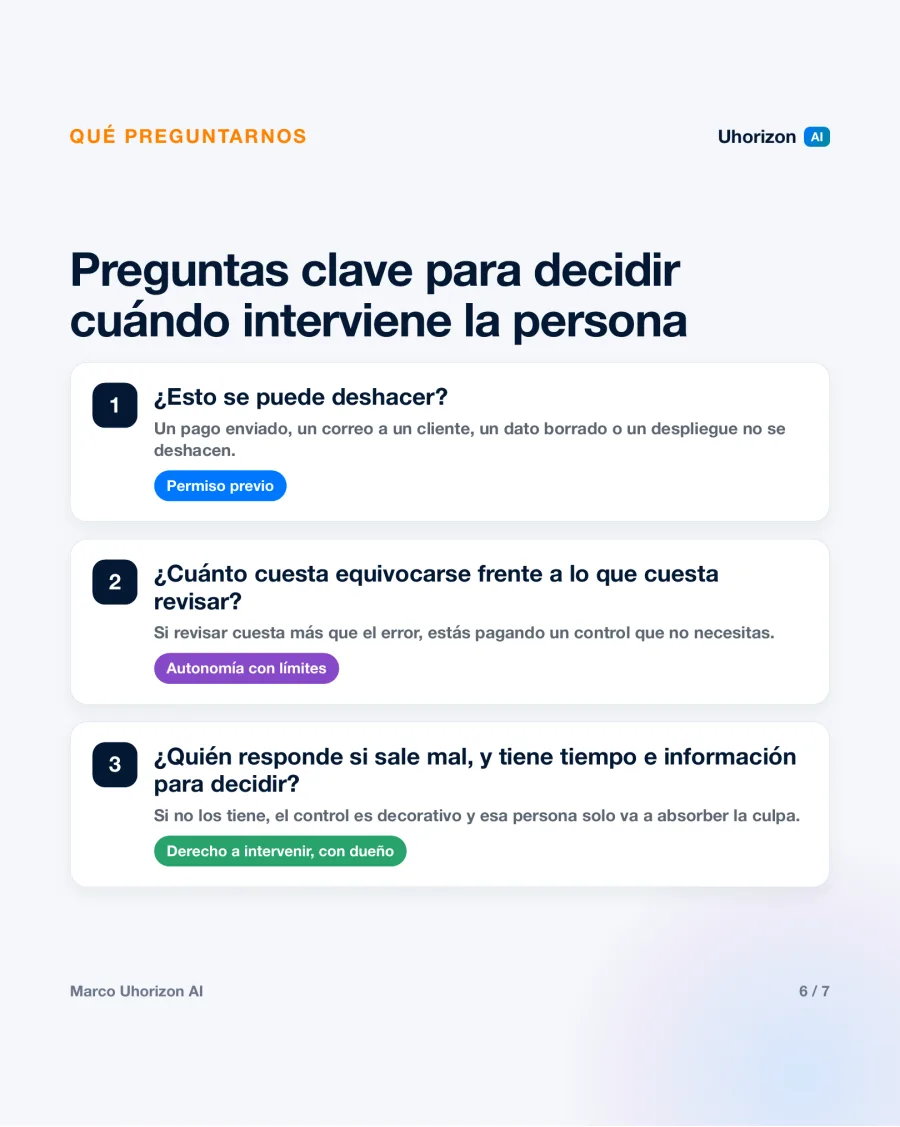
Three questions decide when the person steps in
- Can this be undone? A payment sent, an email to a customer or deleted data can't be undone. That calls for prior approval.
- How much does a mistake cost compared with what reviewing costs? If reviewing costs more than the error, you are paying for a control you don't need. That leaves room for autonomy within limits.
- Who is accountable if it goes wrong, and do they have the time and information to decide? If they don't, the control is decorative and that person will just carry the blame. The right to intervene works when there is an owner who can actually exercise it.
On Monday you can run this exercise with the processes where AI is already operating. Build a simple table with the process, the level of control and the moment the person steps in, and answer the three questions for each row. Most likely you will find at least one process with free rein by default, simply because nobody got around to deciding.
Every process in your operation needs its own answer: where it makes sense for the agent to move ahead on its own, and where it has to go through a person. If you'd like to review it on your processes, let's talk for 30 minutes and go through it together.
Sources
- Gartner, Gartner Says Applying Uniform Governance Across AI Agents Will Lead to Enterprise AI Agent Failure, press release dated May 26, 2026. Projection for 2027.
- The three intermediate levels, the matrix of moments and the three questions are Uhorizon AI's own method.