How to find your company's AI adoption level, by department
From level 0 to 6, how to place your company on the AI adoption scale and why the answer is rarely a single number. Three questions per department.
Juan Miguel Jiménez P. · July 27, 2026 · 5 min read
When I ask what level of AI adoption a company is at, people almost always try to round it to a single number. “I'd say we're a two.” “A three, more or less.” And it's almost never just one.
AI came into companies wherever it could, and almost never with an approved plan and budget: someone in Finance trying something on their own, Marketing rushing to get a piece of copy out, an Operations manager who still isn't sure what it's good for. Sound familiar? That's how technology gets adopted in real life, and it's worth keeping in mind before you give the whole company one grade.
AI adoption breaks down into a starting point and three stages
To talk about it in an orderly way, we use a map of seven maturity levels, grouped into a starting point and three stages of two levels each:
- Level 0, use on personal accounts. Each person uses AI with personal accounts, and nobody sees what data is being shared. The industry calls it shadow AI.
- Levels 1 and 2, Foundations. First an AI usage policy and corporate licenses, then individual productivity: people use AI well in their own work.
- Levels 3 and 4, Build. Targeted automations on specific tasks, and then specialized agents that run part of a process.
- Levels 5 and 6, Scale. A platform where several agents work in coordination and, at the end of the path, an organization that designs its processes around AI.
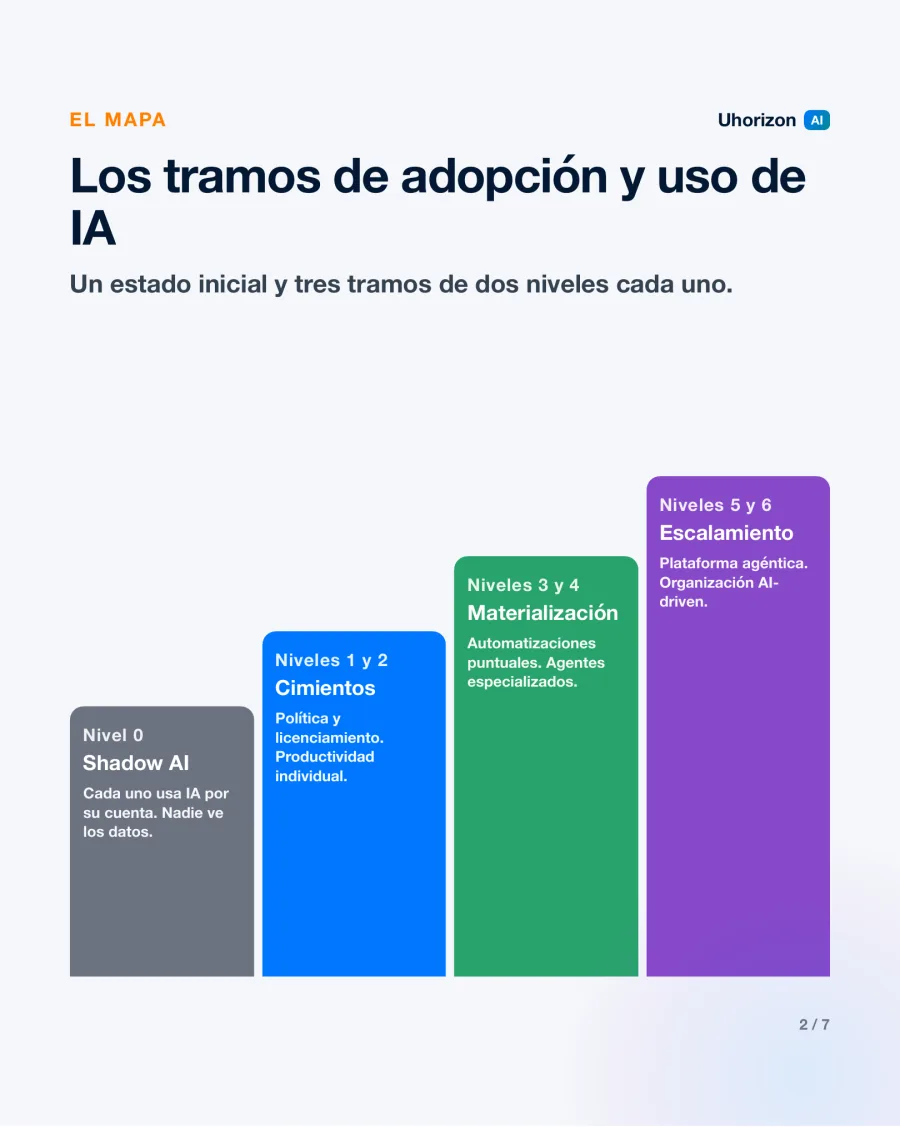
The stages run in order. A company without a usage policy that tries to roll out specialized agents usually discovers the data-sharing problem at the worst possible moment, with customer information moving through personal accounts.
Within the same company, each department can be at a different stage
And that's to be expected. It's normal to find Finance automating its daily reconciliation while Operations is just getting its licenses and accounts in order. AI gets used in different ways depending on the people and the work in each department, so an average for the whole company hides exactly what you want to know.
What's valuable about that gap is that one department has already learned something the others can use. If Finance already figured out how to hand out licenses, what data can be shared and how to review what AI produces, Operations doesn't have to rediscover it from scratch.
Each department moves according to the nature of its work
From what we see, the nature of each department weighs heavily:
- Finance works with standard processes and clear rules, which makes it the most likely to automate.
- Operations has variability and people in the field. Adoption takes more effort there, and it usually stays at Foundations and individual productivity.
- Sales is a good fit for specialized agents that support the sales team, like preparing for a meeting with a prospect or following up on the pipeline.
- Marketing works with text and images all day and adopts quickly at the individual level.
- Legal stays at Foundations on purpose, because risk comes first there, and rightly so.
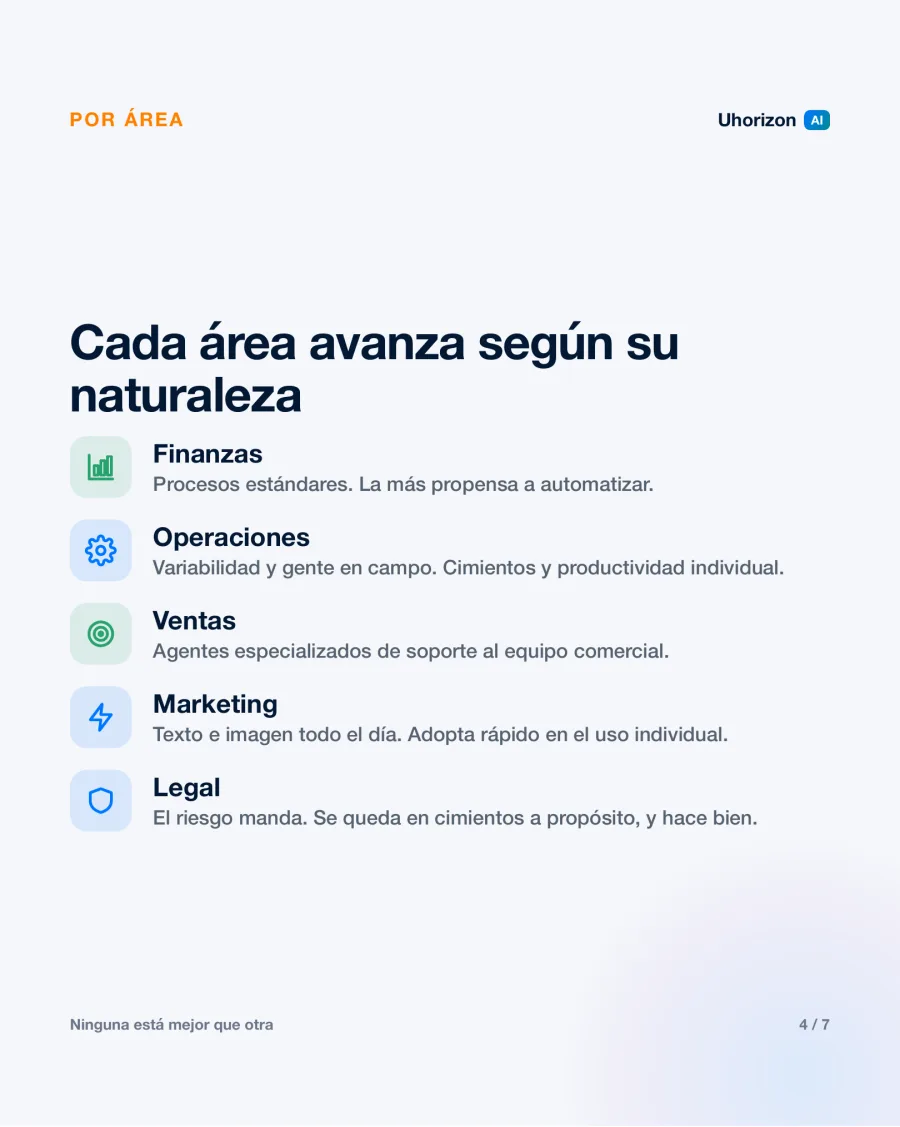
None of them is better for being at a higher stage: each department needs the level its work calls for. It's like a basketball team. You don't train the center and the point guard the same way, and nobody would say one is more advanced than the other. Each one prepares for what they have to do on the court.
A department-by-department map tells you where to put the effort
Here's the practical use. With that map you can decide something concrete: which department to accelerate so the impact on your company is as large as possible. That's where you strengthen the foundations and turn them into results, and from that base you take what worked to the other departments, one stage at a time.
The same map tells you where the company stands as a whole, and that changes what makes sense to do:
- If most departments are at level 0 or in Foundations, the company is getting started with AI, and the first step is getting licenses, policy and individual use in order.
- If there are automations or agents that were launched and aren't delivering results, the work is to get one fully built before opening the next.
- If one department is already seeing results, the question becomes how to govern what works and how to take it to the others.
Three questions are enough to place a department
You don't need a long assessment to place each department. Three questions are enough, asked of the department head:
- Does your team use AI? If so, with what kind of accounts: personal or corporate?
- What task did you stop doing by hand thanks to AI? If there is one, that jump is already Build.
- Is there anything AI does or decides on its own? Think of a workflow that runs within limits the department set: if one exists, an agent is already operating.
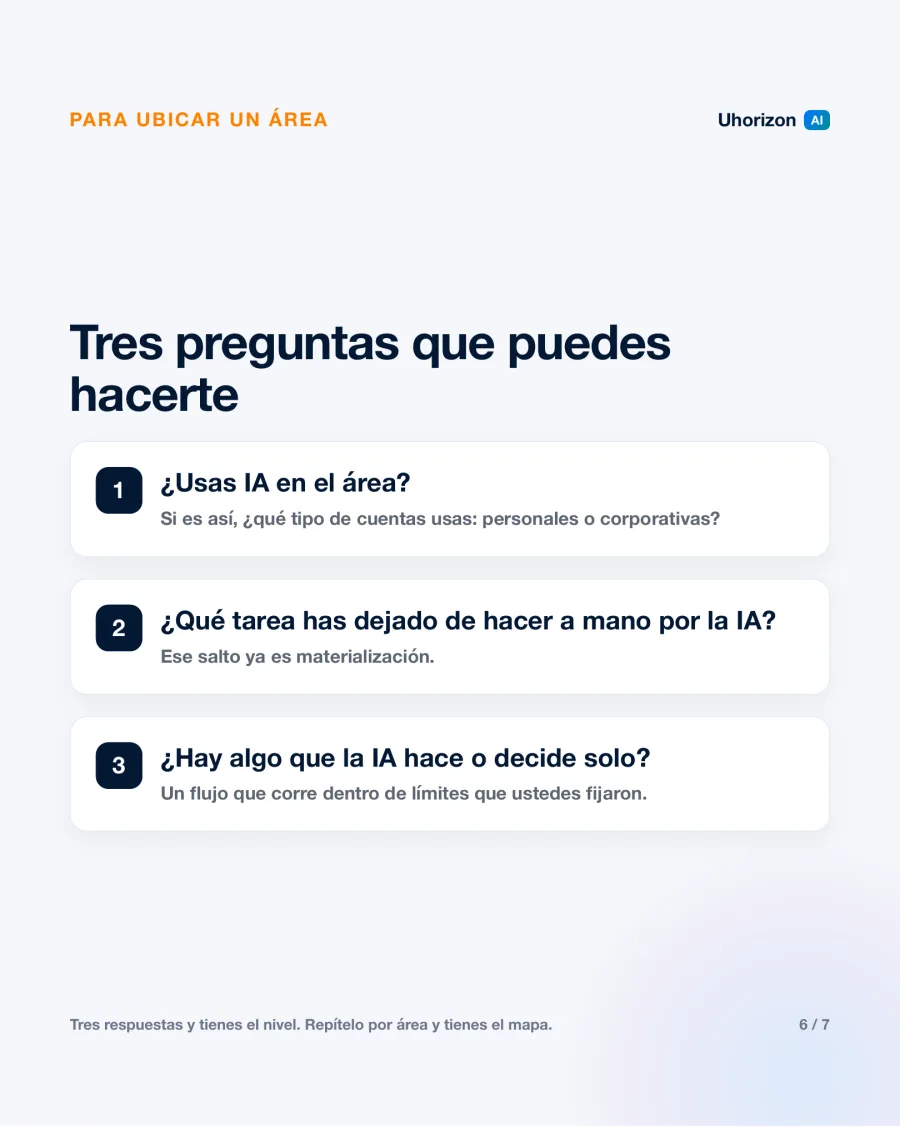
With three answers you place the department in a stage, and if you repeat it with each department you have the company's map. One piece of advice that matters a lot: ask the questions to someone who uses AI every day in that department too. Sometimes the answers from the manager and the team don't match, and that difference is information as well.
On Monday you can do it with three departments, in a fifteen-minute conversation with each department head. Write down the level, the type of accounts and the task that's no longer done by hand. That gives you a first honest picture, which is usually quite different from the number someone would have said in the leadership meeting.
Back to the question at the start: how many numbers would you need to answer with? If you'd like to build that map with someone who has already done it in other companies, let's talk for 30 minutes about your department, the challenges you have and where it makes sense to move forward.